<?xml version="1.0" encoding="utf-8" ?>
<rdf:RDF xmlns:rdf="http://www.w3.org/1999/02/22-rdf-syntax-ns#" xmlns:dc="http://purl.org/dc/elements/1.1/" xmlns:syn="http://purl.org/rss/1.0/modules/syndication/" xmlns="http://purl.org/rss/1.0/">


<channel rdf:about="http://www.inaf.it/en/inaf-news/president/RSS">
  <title>President</title>
  <link>http://www.inaf.it</link>

  <description>


  </description>


            <syn:updatePeriod>daily</syn:updatePeriod>
            <syn:updateFrequency>1</syn:updateFrequency>
            <syn:updateBase>2012-03-05T16:29:47Z</syn:updateBase>
        

  <image rdf:resource="http://www.inaf.it/logo.png"/>

  <items>
    <rdf:Seq>
      
        <rdf:li rdf:resource="http://www.inaf.it/en/inaf-news/the-agile-satellite-re-entered-the-atmosphere"/>
      
      
        <rdf:li rdf:resource="http://www.inaf.it/en/inaf-news/cubes-ca"/>
      
      
        <rdf:li rdf:resource="http://www.inaf.it/en/inaf-news/inaf-meerkat-agreement"/>
      
      
        <rdf:li rdf:resource="http://www.inaf.it/en/inaf-news/prof-damico-passed-away"/>
      
      
        <rdf:li rdf:resource="http://www.inaf.it/en/inaf-news/uv-vs-covid19"/>
      
      
        <rdf:li rdf:resource="http://www.inaf.it/en/inaf-news/iii-italy-ukraine-scientific-meeting-201care-we-alone-in-the-universe-201d"/>
      
      
        <rdf:li rdf:resource="http://www.inaf.it/en/inaf-news/astri-a-new-pathfinder-of-the-arrays-of-cherenkov-telescopes"/>
      
      
        <rdf:li rdf:resource="http://www.inaf.it/en/inaf-news/astri-hamamatsu"/>
      
      
        <rdf:li rdf:resource="http://www.inaf.it/en/inaf-news/GG-Australia-visits-Inaf"/>
      
      
        <rdf:li rdf:resource="http://www.inaf.it/en/inaf-news/inaf-hosts-the-preliminary-round-to-set-up-the-cherenkov-telescope-array-observatory-eric"/>
      
      
        <rdf:li rdf:resource="http://www.inaf.it/en/inaf-news/space-let2019s-go-to-mars"/>
      
      
        <rdf:li rdf:resource="http://www.inaf.it/en/inaf-news/2017-gal-hassin-award-to-battiston-and-d2019amico"/>
      
      
        <rdf:li rdf:resource="http://www.inaf.it/en/inaf-news/the-new-frontiers-in-the-knowledge-of-the-universe.-an-interview-with-nichi-d2019amico"/>
      
      
        <rdf:li rdf:resource="http://www.inaf.it/en/inaf-news/INAF-in-second-place-in-the-world-ranking-of-nature"/>
      
      
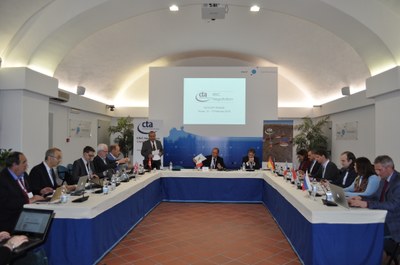
        <rdf:li rdf:resource="http://www.inaf.it/en/inaf-news/cta-will-have-its-permanent-headquarters-in-italy"/>
      
    </rdf:Seq>
  </items>

</channel>


  <item rdf:about="http://www.inaf.it/en/inaf-news/the-agile-satellite-re-entered-the-atmosphere">
    <title>The AGILE satellite re-entered the atmosphere</title>
    <link>http://www.inaf.it/en/inaf-news/the-agile-satellite-re-entered-the-atmosphere</link>
    <description>
	   	   &lt;a href="http://www.inaf.it/en/inaf-news/the-agile-satellite-re-entered-the-atmosphere"&gt;&lt;img src="http://www.inaf.it/en/inaf-news/the-agile-satellite-re-entered-the-atmosphere/@@images/9e0b3d23-5f0b-456f-b08c-73cc87a30c7f.png" alt="The AGILE satellite re-entered the atmosphere" title="The AGILE satellite re-entered the atmosphere" height="70" width="96" /&gt;&lt;/a&gt;
	   	   After 17 years of thriving operations, the AGILE Italian scientific satellite re-entered the atmosphere, thus ending its intense activity as a hunter of some of the most energetic cosmic sources in the Universe that emit gamma and X-rays
	   </description>
    <content:encoded xmlns:content="http://purl.org/rss/1.0/modules/content/"><![CDATA[<p>After 17 years of thriving operations, the AGILE Italian scientific satellite re-entered the atmosphere, thus ending its intense activity as a hunter of some of the most energetic cosmic sources in the Universe that emit gamma and X-rays.<br /><br />AGILE, built by ASI with contributions from INAF and INFN, Italian universities and industry, has been a unique and hugely successful space program in the landscape of Italian space activities. Observations acquired by the satellite were received on the ground by ASI's Luigi Broglio Space Center station in Malindi, Kenya. The data were then sent to the Telespazio Control Center through the ASINet operational network, and then to the ASI Space Science Data Center in Rome, which is responsible for all scientific operations: from management, analysis and archiving to distribution of the data and related catalogs accessible to the international community.<br /><br />AGILE's scientific output consists of more than 800 bibliographic references, including more than 160 refereed articles and 12 mission catalogs published through January 2024 (also available as interactive SSDC webpages <a href="https://agile.ssdc.asi.it/" target="_blank">here</a>).<br /><br />AGILE's major scientific discoveries include: the first detection of galactic cosmic ray sources in Supernovae remnants, evidence of extremely rapid particle acceleration from the Crab Nebula with a rapidly rotating pulsar at its center (Bruno Rossi Prize 2012), and the detection of transient gamma-ray emission associated with relativistic jet emission from the galactic black hole binary system Cygnus X-3.<br /><br />During its operational life, AGILE has also revealed many transient events of cosmic origin such as Gamma Ray Bursts (GRBs), searched for high-energy emission associated to neutrino events and Fast Radio Bursts (FRBs), detected thousands of solar flares, as well as events of terrestrial origin such as Terrestrial Gamma-ray Flashes (TGFs). AGILE has contributed with a leading role in the search for possible counterparts of gravitational wave (GW) sources, and AGILE's follow-up observations have provided the fastest response and most significant upper limits above 100 MeV on all GW events detected by the Ligo-Virgo-Kagra collaboration to date.<br /><br />With the AGILE's re-entry, the in-orbit operational phase comes to a close, but a new phase of scientific work on <a href="https://www.ssdc.asi.it/mmia/index.php?mission=agilemmia" target="_blank">the satellite legacy data archive</a> opens: AGILE may still hold future surprises.<br /><br />Additional links:<br /><br />COMUNICATO STAMPA CONGIUNTO ASI-INAF-INFN (in italian): <a href="https://www.asi.it/2024/02/rientrato-in-atmosfera-il-satellite-agile-dellagenzia-spaziale-italiana/" target="_blank">ASI news</a>, <a href="https://www.media.inaf.it/2024/02/14/agile-fine-missione/" target="_blank">INAF news</a><br /><br /><a href="https://www.ssdc.asi.it/images/2.0/news/AGILE_image_topnews.png" target="_blank"></a></p>]]></content:encoded>
    <dc:publisher>No publisher</dc:publisher>
    <dc:creator>Marco Galliani</dc:creator>
    <dc:rights></dc:rights>
    
      <dc:subject>en-highlights</dc:subject>
    
    
      <dc:subject>en-news</dc:subject>
    
    
      <dc:subject>en-president</dc:subject>
    
    
      <dc:subject>en-events</dc:subject>
    
    <dc:date>2024-02-14T16:50:00Z</dc:date>
    <dc:type>News Item</dc:type>
    
	   <media:content xmlns:media="http://search.yahoo.com/mrss/" type="image/jpeg" url="http://www.inaf.it/en/inaf-news/the-agile-satellite-re-entered-the-atmosphere/image"/>
	    <media:title xmlns:media="http://search.yahoo.com/mrss/">The AGILE satellite re-entered the atmosphere</media:title>
	    <media:thumbnail xmlns:media="http://search.yahoo.com/mrss/" url="http://www.inaf.it/en/inaf-news/the-agile-satellite-re-entered-the-atmosphere/image_thumb"/>
	
  </item>


  <item rdf:about="http://www.inaf.it/en/inaf-news/cubes-ca">
    <title>The operational phase begins for the CUBES spectrograph</title>
    <link>http://www.inaf.it/en/inaf-news/cubes-ca</link>
    <description>
	   	   &lt;a href="http://www.inaf.it/en/inaf-news/cubes-ca"&gt;&lt;img src="http://www.inaf.it/en/inaf-news/cubes-ca/@@images/b7e0c091-3684-4e5c-9211-3f9b2c92adc6.png" alt="The operational phase begins for the CUBES spectrograph" title="The operational phase begins for the CUBES spectrograph" height="64" width="96" /&gt;&lt;/a&gt;
	   	   The operational phase begins for the CUBES (Cassegrain U-Band Efficient Spectrograph) project, an innovative ultraviolet spectrograph to be installed on the European Southern Observatory's Very Large Telescope (ESO's VLT) at the Paranal Observatory in Chile
	   </description>
    <content:encoded xmlns:content="http://purl.org/rss/1.0/modules/content/"><![CDATA[<p><span id="docs-internal-guid-fcf38815-7fff-2920-a908-670420f89316"> </span></p>
<p dir="ltr">The operational phase begins for the <a class="external-link" href="https://cubes.inaf.it/">CUBES</a> (Cassegrain U-Band Efficient Spectrograph) project, an innovative ultraviolet spectrograph to be installed on the European Southern Observatory's Very Large Telescope (ESO's VLT) at the Paranal Observatory in Chile.</p>
<p dir="ltr"><span>The CUBES project is carried out by a consortium of institutes from five countries, led by INAF together with Brazil, Germany, Great Britain and Poland.</span></p>
<p dir="ltr"><span>On 15 February 2022, INAF President Marco Tavani and ESO Director General Xavier Barcons signed the CUBES Construction Agreement. After a preparatory study phase that lasted about a year (the so-called phase A), the operational phase (also called phase B) finally begins, involving the development of the instrument design, its construction and installation at the VLT.</span></p>
<p dir="ltr"><span>“This is the first time that an instrument for the Very Large Telescope has been designed by an Italian-led consortium”, comments </span><span><strong>Marco Tavani</strong></span><span>, President of INAF. "This important stage testifies to the leadership role of the Italian astronomical community on the international scientific arena."</span></p>
<p dir="ltr"><span>Modern telescopes are machines of remarkable complexity that require equally advanced instruments to be used at their best. The design and construction of new astronomical instruments represents a primary effort for the scientific community which sees in this an ambitious synthesis between scientific objectives and engineering opportunities.</span></p>
<p dir="ltr"><span>As evidence of this continuous effort, the most advanced telescopes in the world, such as the VLT, experience the development of several generations of instruments throughout their "life". In this context, the CUBES project is an innovative tool dedicated to observing the sky in the ultraviolet portion of the electromagnetic spectrum, between 300 and 400 nanometers.</span></p>
<p dir="ltr"><span>Astronomers observe the cosmos using a variety of technologies, from Earth and space, across the electromagnetic spectrum as well as through gravitational waves and the detection of neutrinos.</span></p>
<p dir="ltr">"The ultraviolet band is strongly absorbed by our atmosphere", adds <strong>Stefano Cristian</strong><strong>i</strong>, principal investigator (PI) of CUBES, "but it contains unparalleled information on chemical elements, such as beryllium, that are key to understanding the evolution of stars, the explosion of massive objects, including the optical counterparts of gravitational wave sources and also basic aspects of cosmology and fundamental physics".</p>
<p dir="ltr"><span>Building an efficient tool in such a complex observational band requires “a very complex design and optimization effort”, concludes </span><span><strong>Roberto Cirami</strong></span><span>, CUBES project manager.</span></p>
<p> </p>
<p> </p>]]></content:encoded>
    <dc:publisher>No publisher</dc:publisher>
    <dc:creator>Marco Galliani</dc:creator>
    <dc:rights></dc:rights>
    
      <dc:subject>en-highlights</dc:subject>
    
    
      <dc:subject>en-news</dc:subject>
    
    
      <dc:subject>en-president</dc:subject>
    
    
      <dc:subject>en-events</dc:subject>
    
    <dc:date>2022-02-17T19:23:58Z</dc:date>
    <dc:type>News Item</dc:type>
    
	   <media:content xmlns:media="http://search.yahoo.com/mrss/" type="image/jpeg" url="http://www.inaf.it/en/inaf-news/cubes-ca/image"/>
	    <media:title xmlns:media="http://search.yahoo.com/mrss/">The operational phase begins for the CUBES spectrograph</media:title>
	    <media:thumbnail xmlns:media="http://search.yahoo.com/mrss/" url="http://www.inaf.it/en/inaf-news/cubes-ca/image_thumb"/>
	
  </item>


  <item rdf:about="http://www.inaf.it/en/inaf-news/inaf-meerkat-agreement">
    <title>INAF joins the MeerKAT+ Project</title>
    <link>http://www.inaf.it/en/inaf-news/inaf-meerkat-agreement</link>
    <description>
	   	   &lt;a href="http://www.inaf.it/en/inaf-news/inaf-meerkat-agreement"&gt;&lt;img src="http://www.inaf.it/en/inaf-news/inaf-meerkat-agreement/@@images/fd858726-af65-44af-b297-83f4f9ce0008.jpeg" alt="INAF joins the MeerKAT+ Project" title="INAF joins the MeerKAT+ Project" height="66" width="96" /&gt;&lt;/a&gt;
	   	   The South African Radio Astronomy Observatory and the Max-Planck-Gesellschaft welcome the Italian Istituto Nazionale di Astrofisica as partner on the MeerKAT extension project
	   </description>
    <content:encoded xmlns:content="http://purl.org/rss/1.0/modules/content/"><![CDATA[<p>The National Research Foundation, through its national facility the South African Radio Astronomy Observatory (SARAO), and the Max Planck Gesellschaft (MPG) welcome the Istituto Nazionale di Astrofisica (INAF) as an additional partner on the MeerKAT extension project (MeerKAT+).</p>
<p>The MeerKAT+ extension founded by SARAO and MPG will increase both, sensitivity and spatial resolution of the existing MeerKAT telescope array and thus provide a powerful instrument to study the formation and evolution of galaxies throughout the history of the universe.</p>
<p>"INAF and the Italian community are eager to contribute to the MeerKAT+ scientific program and to participate in the technological advance related to its development" says the INAF President, <strong>Marco Tavani</strong>. "MeerKAT+ is an important step towards the SKA Telescope that will open great "unexplored windows" of our Universe".</p>
<p>MeerKAT+ will see <strong>20 new dishes</strong> being added to the existing array of <strong>64 dishes</strong>, a joint project initiated and funded by SARAO and the MPG.</p>
<p>INAF will support MeerKAT+ with an additional financial investment of €6-million. As a result, MeerKAT+ will not only see improved scientific capability, but will also benefit through the scientific participation of INAF.</p>
<p>The MeerKAT project currently has 64 dishes, and the extension will see this number rise to 84. Importantly, the extension will result in the maximum distance between the dishes increasing from 8km to 17km, a move that will increase both MeerKAT’s sensitivity and its ability to capture higher definition radio images. The telescope’s computing requirements will also increase tenfold following these improvements.</p>
<p>MeerKAT+ would be an even more powerful telescope to study the formation and evolution of galaxies throughout the history of the universe.</p>
<p>The extended MeerKAT will increase the raw sensitivity of the instruments by about 50%, a move that will enable the telescope to survey the sky faster, and also enable it to detect even faintest astronomical sources.</p>
<p>MeerKAT+ will eventually be integrated into SKA1-Mid, the first phase of the SKA telescope, which will be an array of 197 dishes.</p>
<p>The MeerKAT+ project was initiated in 2019, and proceeded with thorough scientific evaluation and technical planning. Major tendering for MeerKAT+ is on its way, and first installation activities on site are scheduled for the middle of 2021. Integration and science commissioning of MeerKAT+ is expected to commence in 2023.</p>
<p><strong>----------------------------------------------------</strong></p>
<p><strong>Additional Information</strong></p>
<p>The <strong><a class="external-link" href="https://www.sarao.ac.za/">South African Radio Astronomy Observatory</a></strong> (SARAO), a facility of the National Research Foundation, is responsible for managing all radio astronomy initiatives and facilities in South Africa, including the MeerKAT Radio Telescope in the Karoo, and the Geodesy and VLBI activities at the HartRAO facility. SARAO also coordinates the African Very Long Baseline Interferometry Network (AVN) for the eight SKA partner countries in Africa, as well as South Africa’s contribution to the infrastructure and engineering planning for the Square Kilometre Array Radio Telescope (SKA).</p>
<p>The <strong><a class="external-link" href="https://www.mpg.de/en">Max-Planck-Gesellschaft</a></strong> (MPG) is a non-profit organisation with 86 institutes and research facilities. Among the society’s institutes is the Max-Planck-Institut für Radioastronomie (MPIfR) as a key player in the SKA’s Dish engineering consortium. Together with German industry partners, such as the telescope antenna specialists MT Mechatronics (MTM), and international partners, the Dish consortium is responsible for designing the SKA’s mid-frequency array (SKA-Mid). The MPIfR and MPG have already invested 16 million Euros into MeerKAT earlier in partnership with SARAO to provide a complete state-of-the-art receiver system for all 64 MeerKAT dishes with a so-called beamformer and a high-performance computer cluster to detect radio pulsars and transients, and also for the SKA-DISH demonstrator.</p>
<p>The <strong>Istituto Nazionale di Astrofisica</strong> (INAF) is the main Italian research institute for the study of the Universe, founded in 1999. INAF funds and operates seventeen separate research facilities, which in turn employ scientists, engineers and technical staff. The research they perform covers most areas of astronomy, ranging from planetary science to cosmology.</p>
<p>The <strong><a class="external-link" href="https://www.skatelescope.org/">Square Kilometre Array</a></strong> (SKA) project is an international effort to build the world’s largest radio telescope, with a square kilometre (one million square metres) of collecting area. The SKA telescope will be co-located in Africa and in Australia. It will have an unprecedented scope in observations, exceeding the image resolution quality of the Hubble Space Telescope by a factor of 50 times, whilst also having the ability to image huge areas of sky in parallel.</p>
<p> </p>
<p><b>Coordinated press releases:</b></p>
<ul>
<li><a class="external-link" href="https://www.mpifr-bonn.mpg.de/pressreleases/2020/13">MPIfR press release</a> </li>
<li>SARAO press release</li>
</ul>
<p> </p>
<p><strong>Science contact:</strong></p>
<p>Prof. Dr. <strong>Michael Kramer</strong><br />Director and Head of "Fundamental Physics in Radio Astronomy" Research Dept.<br />Phone:+49 228 525-278<br />Email: mkramer@mpifr-bonn.mpg.de<br />Max-Planck-Institut für Radioastronomie, Bonn</p>
<p>Dr. <strong>Rob Adam</strong><br />SARAO Managing Director<br />Email: rob@ska.ac.za<br />South African Radio Astronomy Observatory (SARAO), Cape Town, South Africa</p>
<p>Dr. <strong>Filippo Zerb</strong>i<br />INAF Scientific Director<br />Email: filippo.zerbi@inaf.it<br />INAF - Istituto Nazionale di AstroFisica, Roma, Italia</p>
<p> </p>
<p><strong>Press contact:</strong></p>
<p> </p>
<p><strong>Khulu Phasiwe</strong><br />Head: Communications &amp; Science Engagement<br />Phone:+27 21 506-7300<br />Email: khulu@ska.ac.za<br />South African Radio Astronomy Observatory (SARAO), Cape Town, South Africa</p>
<p><strong>Marco Galliani</strong><br />INAF Press Office<br />Phone:+39 6 35533-390<br />Email: marco.galliani@inaf.it<br />INAF - Istituto Nazionale di AstroFisica, Roma, Italia</p>
<p>Dr. <strong>Norbert Junkes</strong><br />Press and Public Outreach<br />Phone:+49 228 525-399<br />Email: njunkes@mpifr-bonn.mpg.de<br />Max-Planck-Institut für Radioastronomie, Bonn</p>]]></content:encoded>
    <dc:publisher>No publisher</dc:publisher>
    <dc:creator>Marco Galliani</dc:creator>
    <dc:rights></dc:rights>
    
      <dc:subject>en-highlights</dc:subject>
    
    
      <dc:subject>en-news</dc:subject>
    
    
      <dc:subject>en-president</dc:subject>
    
    
      <dc:subject>en-events</dc:subject>
    
    <dc:date>2020-12-17T09:00:00Z</dc:date>
    <dc:type>News Item</dc:type>
    
	   <media:content xmlns:media="http://search.yahoo.com/mrss/" type="image/jpeg" url="http://www.inaf.it/en/inaf-news/inaf-meerkat-agreement/image"/>
	    <media:title xmlns:media="http://search.yahoo.com/mrss/">INAF joins the MeerKAT+ Project</media:title>
	    <media:thumbnail xmlns:media="http://search.yahoo.com/mrss/" url="http://www.inaf.it/en/inaf-news/inaf-meerkat-agreement/image_thumb"/>
	
  </item>


  <item rdf:about="http://www.inaf.it/en/inaf-news/prof-damico-passed-away">
    <title>Prof. Nichi D'Amico, President of the Italian National Institute for Astrophysics passed away at 67</title>
    <link>http://www.inaf.it/en/inaf-news/prof-damico-passed-away</link>
    <description>
	   	   &lt;a href="http://www.inaf.it/en/inaf-news/prof-damico-passed-away"&gt;&lt;img src="http://www.inaf.it/en/inaf-news/prof-damico-passed-away/@@images/04960021-1f21-4572-bf9e-e481754b4222.jpeg" alt="Prof. Nichi D'Amico, President of the Italian National Institute for Astrophysics passed away at 67" title="Prof. Nichi D'Amico, President of the Italian National Institute for Astrophysics passed away at 67" height="96" width="90" /&gt;&lt;/a&gt;
	   	   
	   </description>
    <content:encoded xmlns:content="http://purl.org/rss/1.0/modules/content/"><![CDATA[<p style="text-align: right; ">September 14, 2020</p>
<p> </p>
<p>Professor Nichi D'Amico, President in office of the Italian National Institute for Astrophysics, passed away on today at his home in Sardinia. Appointed as president INAF in 2015, he was confirmed for a second term on December 2019, the first president to be reconfirmed in the history of this prestigious Italian institution. A famous radio astronomer for his studies on pulsars and professor at University of Cagliari, he was previously director of the Sardinia Radio Telescope, the largest collecting area radio telescope in Europe. He was director of the INAF- Cagliari Astronomical Observatory, the Italian representative at ESO Council and Head of the Italian Delegation at the negotiation who lead the Square Kilometer Array to became an Intergovernmental Organisation (IGO). He received the CSIRO Medal certificate awarded in 1993 and the European Cartesio Prize awarded in 2005 for first discovering of “double pulsar”.</p>]]></content:encoded>
    <dc:publisher>No publisher</dc:publisher>
    <dc:creator>Marco Galliani</dc:creator>
    <dc:rights></dc:rights>
    
      <dc:subject>en-highlights</dc:subject>
    
    
      <dc:subject>en-news</dc:subject>
    
    
      <dc:subject>en-president</dc:subject>
    
    
      <dc:subject>en-events</dc:subject>
    
    <dc:date>2020-09-14T21:45:00Z</dc:date>
    <dc:type>News Item</dc:type>
    
	   <media:content xmlns:media="http://search.yahoo.com/mrss/" type="image/jpeg" url="http://www.inaf.it/en/inaf-news/prof-damico-passed-away/image"/>
	    <media:title xmlns:media="http://search.yahoo.com/mrss/">Prof. Nichi D'Amico, President of the Italian National Institute for Astrophysics passed away at 67</media:title>
	    <media:thumbnail xmlns:media="http://search.yahoo.com/mrss/" url="http://www.inaf.it/en/inaf-news/prof-damico-passed-away/image_thumb"/>
	
  </item>


  <item rdf:about="http://www.inaf.it/en/inaf-news/uv-vs-covid19">
    <title>Ultraviolet light vs. COVID19: from the Sun to artificial lamps the germicidal power of ultraviolet rays against the pandemic</title>
    <link>http://www.inaf.it/en/inaf-news/uv-vs-covid19</link>
    <description>
	   	   &lt;a href="http://www.inaf.it/en/inaf-news/uv-vs-covid19"&gt;&lt;img src="http://www.inaf.it/en/inaf-news/uv-vs-covid19/@@images/6b759d83-6579-4860-8587-43558abd05e8.jpeg" alt="Ultraviolet light vs. COVID19: from the Sun to artificial lamps the germicidal power of ultraviolet rays against the pandemic" title="Ultraviolet light vs. COVID19: from the Sun to artificial lamps the germicidal power of ultraviolet rays against the pandemic" height="72" width="96" /&gt;&lt;/a&gt;
	   	   Results of a study carried out by the Italian National Institute for Astrophysics (INAF) and the University of Milan, in collaboration with Istituto Nazionale Tumori and the Don Gnocchi Foundation of Milan, demonstrate the high germicidal power of short ultraviolet radiation (UV-C) on SARS-COV-2 coronavirus. This result has important public health implications on the strategies to be adopted to manage the pandemic and clearly explain how decontamination and sterilization protocols to prevent SARS-Cov-2 infection must be designed. Notably, taking off from these results a second study explains the role of Sun-derived UV-B/A in conditioning the epidemiology and the worldwide evolution of the COVID-19 pandemic
	   </description>
    <content:encoded xmlns:content="http://purl.org/rss/1.0/modules/content/"><![CDATA[<p>Results show that short <strong>wavelength ultraviolet light</strong> (254 nm, the so-called UV-C rays), typically produced by low cost Mercury lamps (used for example in aquariums to keep water sanitized) <strong>has excellent efficacy in neutralizing the SARS-COV-2 coronavirus</strong>. This is confirmed by a multidisciplinary experimental study that involved a group of researchers with different skills and diverse backgrounds from the <strong>Italian National Institute for Astrophysics</strong> (INAF), the <strong>University of Milan</strong>, the <strong>National Cancer Institute</strong> and the <strong>Don Gnocchi Foundation in Milan</strong>, Italy. The germicidal power of UV-C light on bacteria and viruses is well known as UV-C light inactivates pathogens as a consequence of its ability to induce the breakage of the molecular bonds of DNA and RNA chains inside microbes .</p>
<p>UV-C light-based systems are broadely used for the disinfection of environments and surfaces in hospitals. However a direct measure of the dose necessary to inactivate SARS-CoV-2 had not yet been calculated."We exposed to UV light different concentrations of viruses that were resuspended into acqueous solutions" says <strong>Mara Biasin</strong>, Professor of Applied Biology of the University of Milan "and we found that a<strong> realatively small dose - 3.7 mJ / cm<sup>2</sup></strong>, equivalent to that delivered for just a few seconds by an UV-C lamp placed at a few centimeters from the target – <strong>is sufficient to inactivate and inhibit the reproduction of the virus by a factor of 1000, regardless of its concentration</strong>”. <strong>Andrea Bianco</strong>, Technologist at INAF / Brera Astronomical Observatory in Milan / Merate concludes: "With such small doses it is possible to implement an effective disinfection strategy preventing  SARS-CoV-2 infection. These data will be extremely useful to to develop systems and protocols  to contain the COVID-19 pandemic".</p>
<p>These result were also instrumental in validating a parallel study, coordinated by INAF and the University of Milano, that showed how the ultraviolet rays produced by the Sun modulate the epidemiology of the COVID-19 pandemic by inactivating SARS-CoV-2 contained in the droplets produced by people when they speak, cough, or sneeze. In this case, the short wavelenght UV-C ultraviolet rays (produced by the Sun but absorbed by the ozone layer of our atmosphere) do not act directly, but viral inactivation is driven by UV-B and UV-A rays with a wavelength between about 290 and 400 nanometers.  Thus, <strong>in summer just a few minutes are sufficient for Sun-derived UV-B and UV-A rays to  inactivate the virus,  Fabrizio Nicastro</strong>, INAF researcher at the Astronomical Observatory of Rome comments: "Our study quite well explains how the COVID19 pandemic developed with a maximal virulence in the northern Earth hemisphere during the first months of the year while it is now moving its peak towards the countries of the southern hemisphere, where the winter has begun".</p>
<p>Although other factors, and in particular social distancing have likely played  a role in the reduction of the infection that has been observed in Italy in the last period, it will be important to analyze whether a second wave of SARS-CoV-2 infection will be seen in autumn, when the amount of Sun-derived UV-B and UV-A rays will naturally diminish.  Notably, these results are in good agreement with the model originally proposed in 2005 by Lytle and Sagripanti in order to explain the seasonal trend of certain viruses, such as e.g. the influenza viruses.  "These studies are of great importance in the context of combating the COVID19 pandemic and demonstrate how the integration of apparently compeletly different competences can lead to excellent results" says <strong>Mario Clerici</strong>, of the University of Milan and the Don Gnocchi Foundation. "The activities undertaken by Inaf and targetting t the COVID19 pandemic began last March on the specific impulse by the Ministry of University and Research to all Universities and Research Bodies. The technologies and skills developed in the astrophysical field are now applied and highly useful for civil society and are useful for industrial developments"observes <strong>Giovanni Pareschi </strong>of INAF / Astronomical Observatory of Brera.</p>
<p>"INAF's contribution to solving the COVID-19 pandemics goes beyond the specific technological skills in dealing with radiation" says INAF President <strong>Nichi D'Amico </strong>with satisfaction, and continues: "there is another deeper aspect, connected to one of the main themes of modern astrophysics, namely the search for life forms in the Universe, which with Astrobiology sees precisely the development of advanced knowledge and technologies looking for primordial life forms (i.e. organic molecules, bacteria, viruses) in the Universe in the attempt to understand the role of radiations, and in general of environmental factors, in the development of life in other worlds".</p>
<p>Pending publication in international journals, these results have been published in two preprints of the international medrxiv archive at the following URLs:</p>
<ul>
<li> A. Bianco, M. Biasin, G. Pareschi, et al, <a class="external-link" href="https://www.medrxiv.org/content/10.1101/2020.06.05.20123463v1">UV-C irradiation is highly effective in inactivating and inhibiting SARS-CoV-2 replication</a></li>
<li>F. Nicastro, G. Sironi, E. Antonello, et al., <a class="external-link" href="https://www.medrxiv.org/content/10.1101/2020.06.03.20121392v1">Modulation of COVID-19 Epidemiology by UV-B and -A Photons from the Sun</a></li>
</ul>]]></content:encoded>
    <dc:publisher>No publisher</dc:publisher>
    <dc:creator>Marco Galliani</dc:creator>
    <dc:rights></dc:rights>
    
      <dc:subject>en-highlights</dc:subject>
    
    
      <dc:subject>en-news</dc:subject>
    
    
      <dc:subject>en-president</dc:subject>
    
    
      <dc:subject>en-events</dc:subject>
    
    <dc:date>2020-06-15T15:20:00Z</dc:date>
    <dc:type>News Item</dc:type>
    
	   <media:content xmlns:media="http://search.yahoo.com/mrss/" type="image/jpeg" url="http://www.inaf.it/en/inaf-news/uv-vs-covid19/image"/>
	    <media:title xmlns:media="http://search.yahoo.com/mrss/">Ultraviolet light vs. COVID19: from the Sun to artificial lamps the germicidal power of ultraviolet rays against the pandemic</media:title>
	    <media:thumbnail xmlns:media="http://search.yahoo.com/mrss/" url="http://www.inaf.it/en/inaf-news/uv-vs-covid19/image_thumb"/>
	
  </item>


  <item rdf:about="http://www.inaf.it/en/inaf-news/iii-italy-ukraine-scientific-meeting-201care-we-alone-in-the-universe-201d">
    <title>III Italy-Ukraine Scientific Meeting “Are We Alone in the Universe?”</title>
    <link>http://www.inaf.it/en/inaf-news/iii-italy-ukraine-scientific-meeting-201care-we-alone-in-the-universe-201d</link>
    <description>
	   	   &lt;a href="http://www.inaf.it/en/inaf-news/iii-italy-ukraine-scientific-meeting-201care-we-alone-in-the-universe-201d"&gt;&lt;img src="http://www.inaf.it/en/inaf-news/iii-italy-ukraine-scientific-meeting-201care-we-alone-in-the-universe-201d/@@images/e64246e2-1695-4e9c-8709-73157183ab64.jpeg" alt="III Italy-Ukraine Scientific Meeting “Are We Alone in the Universe?”" title="III Italy-Ukraine Scientific Meeting “Are We Alone in the Universe?”" height="96" width="95" /&gt;&lt;/a&gt;
	   	   A Virtual Conference on the Occasion of the Italian Research Day in the World
	   </description>
    <content:encoded xmlns:content="http://purl.org/rss/1.0/modules/content/"><![CDATA[<p style="text-align: justify; ">On June 9-11, 2020, the III Italy-Ukraine Conference celebrating the Italian Research Day in the World will be held, this year in a webinar format due to the COVID-19 emergency that made traveling impossible.</p>
<p style="text-align: justify; ">Organized at the initiative of the Embassy of Italy to Ukraine (Kyiv), V. N. Karazin Kharkiv National University (Ukraine), and INAF — National Institute of Astrophysics (Italy), the web meeting deals with the question: “Are We Alone in the Universe?”, a very topical issue addressed in different aspects: scientific, technological, astrophysical, philosophical, sociological, legal, historical, biological, futurological, theological, and many more.</p>
<p style="text-align: justify; "><span style="text-align: justify; "><strong>16:00-17:45 Italian time </strong><strong>or </strong></span><span>17:00-18:45 Ukrainian time</span></p>
<p style="text-align: justify; ">The conference can be accessed at the following <a href="https://www.youtube.com/c/KarazinUniver" target="_blank">link</a>.</p>
<p style="text-align: justify; ">The scientific reports by qualified specialists will be delivered with subtitles in Italian, Ukrainian, and English.</p>
<p style="text-align: justify; ">For more information, please read the <a href="https://www.univer.kharkov.ua/images/redactor/news/2020-06-03/Are-we-alone-at-the-Universe-program-eng1.pdf" target="_blank">Agenda</a> (PDF, 7,82 Mb)</p>]]></content:encoded>
    <dc:publisher>No publisher</dc:publisher>
    <dc:creator>Marco Galliani</dc:creator>
    <dc:rights></dc:rights>
    
      <dc:subject>en-highlights</dc:subject>
    
    
      <dc:subject>en-news</dc:subject>
    
    
      <dc:subject>en-president</dc:subject>
    
    
      <dc:subject>en-events</dc:subject>
    
    <dc:date>2020-06-04T15:32:10Z</dc:date>
    <dc:type>News Item</dc:type>
    
	   <media:content xmlns:media="http://search.yahoo.com/mrss/" type="image/jpeg" url="http://www.inaf.it/en/inaf-news/iii-italy-ukraine-scientific-meeting-201care-we-alone-in-the-universe-201d/image"/>
	    <media:title xmlns:media="http://search.yahoo.com/mrss/">III Italy-Ukraine Scientific Meeting “Are We Alone in the Universe?”</media:title>
	    <media:thumbnail xmlns:media="http://search.yahoo.com/mrss/" url="http://www.inaf.it/en/inaf-news/iii-italy-ukraine-scientific-meeting-201care-we-alone-in-the-universe-201d/image_thumb"/>
	
  </item>


  <item rdf:about="http://www.inaf.it/en/inaf-news/astri-a-new-pathfinder-of-the-arrays-of-cherenkov-telescopes">
    <title>ASTRI: a new pathfinder of the arrays of Cherenkov telescopes</title>
    <link>http://www.inaf.it/en/inaf-news/astri-a-new-pathfinder-of-the-arrays-of-cherenkov-telescopes</link>
    <description>
	   	   &lt;a href="http://www.inaf.it/en/inaf-news/astri-a-new-pathfinder-of-the-arrays-of-cherenkov-telescopes"&gt;&lt;img src="http://www.inaf.it/en/inaf-news/astri-a-new-pathfinder-of-the-arrays-of-cherenkov-telescopes/@@images/ea49ce02-6115-4511-a01e-562e18c46d96.jpeg" alt="ASTRI: a new pathfinder of the arrays of Cherenkov telescopes" title="ASTRI: a new pathfinder of the arrays of Cherenkov telescopes" height="96" width="72" /&gt;&lt;/a&gt;
	   	   On June 12nd 2019, in La Laguna (Tenerife, Spain) Prof. Nichi D’Amico, President of the Italian National Institute for Astrophysics (INAF), and Prof. Rafael Rebolo Lopez, Director of the Instituto de Astrofisica de Canaries, signed a Record of Understanding to enter a detailed negotiation on a technical and programmatic basis aimed to install and operate the ASTRI Mini-Array at the Observatorio del Teide
	   </description>
    <content:encoded xmlns:content="http://purl.org/rss/1.0/modules/content/"><![CDATA[<p>On June 12nd 2019, in La Laguna (Tenerife, Spain) Prof. Nichi D’Amico, President of the Italian National Institute for Astrophysics (INAF), and Prof. Rafael Rebolo Lopez, Director of the Instituto de Astrofisica de Canaries, signed a Record of Understanding to <i>enter a detailed negotiation on a technical and programmatic basis aimed to install and operate the ASTRI Mini-Array at the Observatorio del Teide</i>.</p>
<p>This is an important step forward for the ASTRI Collaboration among INAF, the Universidade de Sao Paulo in Brazil and the North-Western University in South Africa, including now the prestigious Spanish institution.</p>
<table class="invisible">
<tbody>
<tr style="text-align: center; ">
<th><img class="image-inline" src="../../resolveuid/19731708-b919-4b53-b7f9-47294a4dd97d/@@images/image/preview" /></th>
</tr>
<tr>
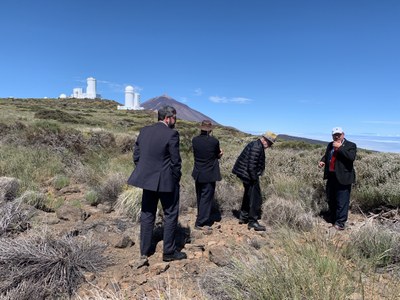
<td style="text-align: center; "><i>INAF and IAC Representatives on the Teide Observatory site</i></td>
</tr>
</tbody>
</table>
<p>ASTRI (Astrofisica con Specchi a Tecnologia Replicante Italiana), was born in 2011 as a Flag-ship Project of the Italian Ministry for Education and Research (MIUR) in order to establish a new and innovative end-to-end technology dedicated to the implementation of Cherenkov imaging telescopes  for high energy astrophysics. The project was again funded in 2015 in order to finalize a collection of up to nine telescopes to be operated as an array.  This option, already foreseen in the original Project, and denominated “ASTRI Mini-Array”, is now prone to be implemented on an adequate observing site, and launched towards an authoritative “early science” by using the technique of Cherenkov telescopes arrays.</p>
<table class="invisible">
<tbody>
<tr>
<th><img class="image-inline" src="../../resolveuid/cbcd7e74-5204-4443-9f5f-68392551d503/@@images/image/preview" /></th>
</tr>
<tr>
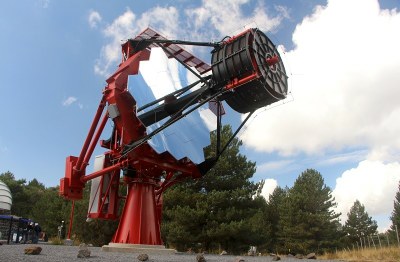
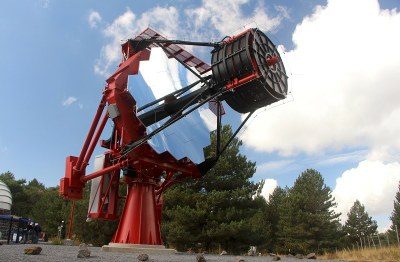
<td><i>ASTRI-Horn  prototype telescope, which is installed since a few years  at the  astronomical INAF site on the slopes of the Etna Mount in Sicily</i></td>
</tr>
</tbody>
</table>
<p>The first ASTRI prototype was installed at INAF Serra La Nave Observatory in Sicily, and was inaugurated in 2014. Subsequently dedicated to Guido Horn d’Arturo, the Italian astronomer first proposer of the segmented mirror concept, ASTRI-Horn observed in December 2018 gamma ray emission from the Crab Nebulae, becoming the first world-wide double-mirrors Cherenkov telescope producing an astronomical observation.</p>
<p>New improved mechanical structures are already ordered in the Italian industry, while <a href="http://www.inaf.it/en/inaf-news/astri-hamamatsu" class="internal-link">a very recent news</a> announced having assigned to Italian Hamamatsu Photonics the production of more than twenty five thousands pixels of silicon photomultiplier for the cameras.</p>
<p>The Record signed today, enters the technical evaluation for the installation on a short time scale of the ASTRI Mini-Array at Teide Observatory.</p>]]></content:encoded>
    <dc:publisher>No publisher</dc:publisher>
    <dc:creator>Marco Galliani</dc:creator>
    <dc:rights></dc:rights>
    
      <dc:subject>en-highlights</dc:subject>
    
    
      <dc:subject>en-news</dc:subject>
    
    
      <dc:subject>en-president</dc:subject>
    
    
      <dc:subject>en-events</dc:subject>
    
    <dc:date>2019-06-13T10:45:00Z</dc:date>
    <dc:type>News Item</dc:type>
    
	   <media:content xmlns:media="http://search.yahoo.com/mrss/" type="image/jpeg" url="http://www.inaf.it/en/inaf-news/astri-a-new-pathfinder-of-the-arrays-of-cherenkov-telescopes/image"/>
	    <media:title xmlns:media="http://search.yahoo.com/mrss/">ASTRI: a new pathfinder of the arrays of Cherenkov telescopes</media:title>
	    <media:thumbnail xmlns:media="http://search.yahoo.com/mrss/" url="http://www.inaf.it/en/inaf-news/astri-a-new-pathfinder-of-the-arrays-of-cherenkov-telescopes/image_thumb"/>
	
  </item>


  <item rdf:about="http://www.inaf.it/en/inaf-news/astri-hamamatsu">
    <title>Important industrial contract assigned in the context of the ASTRI gamma-ray astronomy project</title>
    <link>http://www.inaf.it/en/inaf-news/astri-hamamatsu</link>
    <description>
	   	   &lt;a href="http://www.inaf.it/en/inaf-news/astri-hamamatsu"&gt;&lt;img src="http://www.inaf.it/en/inaf-news/astri-hamamatsu/@@images/8285d4e8-7c05-4d35-af88-c3ce0d02e32f.jpeg" alt="Important industrial contract assigned in the context of the ASTRI gamma-ray astronomy project" title="Important industrial contract assigned in the context of the ASTRI gamma-ray astronomy project" height="75" width="96" /&gt;&lt;/a&gt;
	   	   The National Institute for Astrophysics takes another important step towards the creation of the ASTRI range mini-array of telescopes, assigning to Hamamatsu Photonics Italia the tender for the realization of silicon sensors that will equip the cameras with images of the innovative double-mirror telescopes "Made in INAF", for an amount exceeding one million euros
	   </description>
    <content:encoded xmlns:content="http://purl.org/rss/1.0/modules/content/"><![CDATA[<p style="text-align: left; ">INAF, the Italian National Institute of Astrophysics, takes another step forward for the realization of the mini-array of 9 ASTRI telescopes, assigning to the Italian section of the Hamamatsu Photonics Company the realization of over 25 thousand SiPM silicon sensors (Silicon Photo-Multiplier) in response to a competitive tender for a final amount of € 1.03 millions. The SiPM sensors will cover the wide field of view Cherenkov cameras based on innovative technology "made in INAF", which will be mounted on the focal planes of the ASTRI telescopes, designed to observe the universe in gamma rays.</p>
<p style="text-align: left; ">The cutting-edge technologies of the ASTRI mini-array refer to those developed and already used for the first ASTRI-Horn prototype telescope, which is installed since a few years at the astronomical INAF site on the slopes of the Etna Mount in Sicily. In particular, the ASTRI telescopes adopt for the first time a wide-field, two-mirror Schwarzschild-Couder-type optical configuration, whose functionality was recently proven with the observation of the Crab nebula in gamma rays with the ASTRI-Horn telescope. INAF considers very important the development of the ASTRI mini-array, both to produce state-of-the-art data and to gain experience in view of the subsequent implementation of the international Cherenkov Telescope Array Observatory (CTAO) project which involves the use of a number of very large telescopes (118) distributed in two places in the northern and southern hemisphere of the Earth.</p>
<table class="invisible">
<tbody>
<tr style="text-align: center; ">
<th><img class="image-inline" src="../../resolveuid/fc566b1f-e4ca-4f13-b8fc-275c0f6ef7c4/@@images/image/preview" /><img src="http://www.inaf.it/en/inaf-news/astri-hamamatsu" alt="Important industrial contract assigned in the context of the ASTRI gamma-ray astronomy project" id="__mce_tmp" title="Important industrial contract assigned in the context of the ASTRI gamma-ray astronomy project" /></th>
</tr>
<tr>
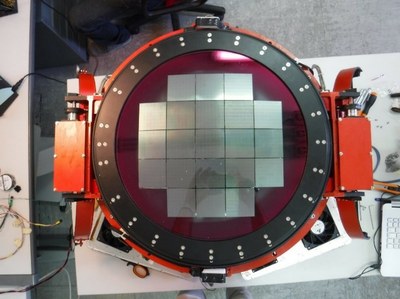
<td style="text-align: center; "><i>The Cherenkov Chamber</i></td>
</tr>
</tbody>
</table>
<p>The Cherenkov chamber developed by INAF for the focal plane of each telescope, thanks to its two-mirror configuration, is very compact (just 60 cm in diameter) and is based on innovative electronics and electro-mechanical systems. Each chamber, whose detection plane is curved due to technical requirements, will mount approximately 2400 SiPM-type square silicon sensors, with sides of about 7 mm. A total of eleven rooms will be built for the ASTRI / Mini-array project, one for engineering and qualification activities and one for reserve. The SiPM sensors represent the latest generation of light detection systems. The high photo-detection efficiency and a large collection area make them very efficient for the detection of gamma photons emitted by celestial sources.</p>
<p>Following the awarding of the tender to Hamamatsu, INAF president Nichi D’Amico says: “A very important day, a remarkable scientific milestone. After the realization of the ASTRI prototype in Sicily we are now starting the construction of the mini-array of the ASTRI telescopes to the mini-array, one of the most important precursors of CTA. The devices we asked to build in Hamamatsu are technologically advanced, and this is important because we inject innovation aspects into the industrial system: they are sensors that could have applications in many fields tomorrow, and so we are also proud about that ”.</p>
<p>Also Koei Yamamoto, Senior Managing Director of Hamamatsu Photonics KK (Japan) wanted to comment on the news: "We are happy to participate in the ASTRI project by providing large-scale, low-noise solid-state Si-based sensors. We afford this technology challenge thanks to the  research and development efforts that began a few years ago".</p>
<p> </p>
<p><b>Information on the ASTRI project and the Cherenkov technique</b></p>
<table class="invisible">
<tbody>
<tr>
<th><img class="image-inline" src="../../resolveuid/b1d4dba5-78a2-4a6f-86d0-f6c9c04c0961/@@images/image/preview" /></th>
</tr>
<tr>
<td style="text-align: center; "><i>ASTRI-Horn prototype telescope, which is installed since a few years at the astronomical INAF site on the slopes of the Etna Mount in Sicily.</i></td>
</tr>
</tbody>
</table>
<p style="text-align: left; ">The ASTRI project (Astrophysics with Mirrors with Italian replicating technology) is coordinated by INAF, with the support of the Italian Ministry of Education, University and Research (MIUR) and in collaboration with various national and international partners (Universities of Padova and Perugia, INFN, Universidade de São Paulo and FAPEST - Brazil, North-West University South Africa). The goal is the design, implementation and astronomical use for the Italian and international scientific community of a group of 9 telescopes for high-energy gamma-ray observations from Earth with the Cherenkov technique, in the spectral region in gamma rays up to 300 TeV – an almost unexplored energy band even for the most modern particle accelerators. The observations of ASTRI will allow us to study phenomena of fundamental importance to understand our Universe, such as the origin and acceleration in the remains of Supernova of cosmic rays and physics in relativistic regime related to the emission of gamma photons in Galactic Nuclei active.</p>
<p>The ASTRI mini-array utilizes the Cherenkov technique for observing gamma rays. This approach is based on the detection of the so-called Cherenkov light that is generated in the interaction of gamma rays with the atmosphere. High energy gamma rays coming into contact with the earth's atmosphere produce cascades of subatomic particles; these very energetic particles can travel in the air even faster than the speed of light, giving rise to a faint (and very short, of the order of a billionth of a second) flash of bluish light which, once collected by telescopes, can be traced back to the primary emission in gamma rays.</p>
<p> </p>
<p><b>For further information:</b></p>
<p><b><br /></b></p>
<p>INAF PR Office: tel. +39 06.355.33390 cell. +39 335 1778428 <a href="mailto:marco.galliani@inaf.it">marco.galliani@inaf.it</a></p>
<p>Giovanni Pareschi, PI of the ASTRI Project : cell 3316113735, giovanni.pareschi@inaf.it</p>]]></content:encoded>
    <dc:publisher>No publisher</dc:publisher>
    <dc:creator>Marco Galliani</dc:creator>
    <dc:rights></dc:rights>
    
      <dc:subject>en-highlights</dc:subject>
    
    
      <dc:subject>en-president</dc:subject>
    
    
      <dc:subject>en-events</dc:subject>
    
    <dc:date>2019-06-05T17:00:00Z</dc:date>
    <dc:type>News Item</dc:type>
    
	   <media:content xmlns:media="http://search.yahoo.com/mrss/" type="image/jpeg" url="http://www.inaf.it/en/inaf-news/astri-hamamatsu/image"/>
	    <media:title xmlns:media="http://search.yahoo.com/mrss/">Important industrial contract assigned in the context of the ASTRI gamma-ray astronomy project</media:title>
	    <media:thumbnail xmlns:media="http://search.yahoo.com/mrss/" url="http://www.inaf.it/en/inaf-news/astri-hamamatsu/image_thumb"/>
	
  </item>


  <item rdf:about="http://www.inaf.it/en/inaf-news/GG-Australia-visits-Inaf">
    <title>The Governor-General of Australia visits INAF in Rome</title>
    <link>http://www.inaf.it/en/inaf-news/GG-Australia-visits-Inaf</link>
    <description>
	   	   &lt;a href="http://www.inaf.it/en/inaf-news/GG-Australia-visits-Inaf"&gt;&lt;img src="http://www.inaf.it/en/inaf-news/GG-Australia-visits-Inaf/@@images/a70bd844-fea9-48bb-bd52-4d8f49a51495.jpeg" alt="The Governor-General of Australia visits INAF in Rome" title="The Governor-General of Australia visits INAF in Rome" height="86" width="96" /&gt;&lt;/a&gt;
	   	   His Excellency the Governor-General of the Commonwealth of Australia, Sir Peter Cosgrove, and his wife, Lady Cosgrove, today visited the Headquarters of INAF, the Italian National Institute for Astrophysics
	   </description>
    <content:encoded xmlns:content="http://purl.org/rss/1.0/modules/content/"><![CDATA[<p>His Excellency the Governor-General of the Commonwealth of Australia, Sir Peter Cosgrove, and his wife, Lady Cosgrove, today visited the Headquarters of INAF, the Italian National Institute for Astrophysics. In the framework of the official visit to Italy and the Holy See, the Governor-General also met the President of the Italian Republic, Sergio Mattarella, Pope Francis, and Italian and Australian entrepreneurs.</p>
<p>The Governor-General and Lady Cosgrove, together with Australian Ambassador to Italy Dr Greg French, met the President of INAF, Professor Nichi D’Amico, and his senior staff, who explained the role of INAF and highlighted the close links between astrophysicists in the two countries who work together on global challenges to develop world-class research infrastructure. Such projects include the Square Kilometre Array, the largest radio telescope in the world whose low frequency array will be deployed in Western Australia, where INAF intends to focus a significant fraction of its involvement in the project.</p>
<p>“It’s a great honour for the Italian astronomical community to be visited by His Excellency the Governor-General”, said Nichi D’Amico. “This visit is a sign of the close relations between Australia and Europe, and the special role that Italy plays in this relationship”.</p>
<p>The Governor-General and Lady Cosgrove were fascinated by Villa Mellini, the historic building that houses the INAF Headquarters, and by the unique exhibition of ancient astronomical instruments, as well to hear about the next-generation research infrastructure that will observe the universe, such as SKA, EELT and CTA. These projects will increase knowledge of the universe and strengthen the relations which Australian scientists enjoy with INAF, a global player in astronomy and astrophysics research.</p>
<p>During the visit the Governor-General said "Australia and Italy are partners in the pursuit of greater knowledge about our universe. It was wonderful to hear how INAF's work, in collaboration with Australian scientists and researchers, will help make important future scientific discoveries."</p>
<p><iframe frameborder="0" height="315" src="https://www.youtube.com/embed/WUAB2_eNpHc" width="560"></iframe></p>]]></content:encoded>
    <dc:publisher>No publisher</dc:publisher>
    <dc:creator>Marco Galliani</dc:creator>
    <dc:rights></dc:rights>
    
      <dc:subject>en-highlights</dc:subject>
    
    
      <dc:subject>en-news</dc:subject>
    
    
      <dc:subject>en-president</dc:subject>
    
    
      <dc:subject>en-events</dc:subject>
    
    <dc:date>2018-06-27T14:00:00Z</dc:date>
    <dc:type>News Item</dc:type>
    
	   <media:content xmlns:media="http://search.yahoo.com/mrss/" type="image/jpeg" url="http://www.inaf.it/en/inaf-news/GG-Australia-visits-Inaf/image"/>
	    <media:title xmlns:media="http://search.yahoo.com/mrss/">The Governor-General of Australia visits INAF in Rome</media:title>
	    <media:thumbnail xmlns:media="http://search.yahoo.com/mrss/" url="http://www.inaf.it/en/inaf-news/GG-Australia-visits-Inaf/image_thumb"/>
	
  </item>


  <item rdf:about="http://www.inaf.it/en/inaf-news/inaf-hosts-the-preliminary-round-to-set-up-the-cherenkov-telescope-array-observatory-eric">
    <title>INAF hosts the preliminary round to set up  the Cherenkov Telescope Array Observatory-ERIC</title>
    <link>http://www.inaf.it/en/inaf-news/inaf-hosts-the-preliminary-round-to-set-up-the-cherenkov-telescope-array-observatory-eric</link>
    <description>
	   	   &lt;a href="http://www.inaf.it/en/inaf-news/inaf-hosts-the-preliminary-round-to-set-up-the-cherenkov-telescope-array-observatory-eric"&gt;&lt;img src="http://www.inaf.it/en/inaf-news/inaf-hosts-the-preliminary-round-to-set-up-the-cherenkov-telescope-array-observatory-eric/@@images/1e284431-edc6-491c-8b1f-ffbfd2cb4214.jpeg" alt="INAF hosts the preliminary round to set up  the Cherenkov Telescope Array Observatory-ERIC" title="INAF hosts the preliminary round to set up  the Cherenkov Telescope Array Observatory-ERIC" height="54" width="96" /&gt;&lt;/a&gt;
	   	   At Headquarters of the Italian National Institute for Astrophysics INAF, the kick-off round of the multilateral negotiations to establish an ERIC organization to the manage the Cherenkov Telescope Array project as part of the EU’s ESFRI infrastructure roadmap had take place
	   </description>
    <content:encoded xmlns:content="http://purl.org/rss/1.0/modules/content/"><![CDATA[<p>Rome: March 13<sup>th</sup> 2018, at Headquarters of the Italian National Institute for Astrophysics INAF, the kick-off round of the multilateral negotiations to establish an ERIC organization to the manage the Cherenkov Telescope Array project as part of the EU’s ESFRI infrastructure roadmap had take place.</p>
<p>This initiative was leaded by the Italian Government based on a resolution of the CTAO gGbmH – (Cherenkov Telescope Array Observatory), the organization which is currently in charge of managing the project, whose Council decided, unanimously, to select Italy, under INAF’s management, to host the final legal entity which will govern and run the Observatory.</p>
<p>The Italian Government proposed the ERIC legal formula to run a global project, whose infrastructure will be located outside Europe and involves scientists from more than 20 Countries.</p>
<p><img class="image-inline" src="../../resolveuid/db3477f2-ec61-4c52-8144-acb3a8a4fbde/@@images/image/preview" /></p>
<p><i>“The aim is to make Europe a hub for global science”,</i> said Nichi D’Amico, president of INAF, <i>“in a world where science is increasing the need for large scale research infrastructure, set-up appealing research infrastructures is a must of any initiative. INAF is contributing to the CTA world-class project by providing the best scientific environment for the CTAO HQ, which will be located in Bologna, as well by promoting the most inclusive membership policy in the CTAO governance. We are convinced that ERIC will provide the optimum legal framework to allows to advance the scientific collaboration at global level. This also adds to INAF’s credibility as a global science leader and we want to strengthen our contribution and platform in the years ahead.</i></p>
<p><i> </i></p>
<p>In addition, President D’Amico said <i>“</i><i>Europe is playing a leading global role in the concept construction of the major astronomical infrastructures of the future: we can see significant progress with the European Extremely Large Telescope, E-ELT.  The Square Kilometer Array, SKA, has completed the political negotiations and it is evolving into an IGO.  These two major infrastructures will be operative in parallel with the Cherenkov Telescope Array, CTA. Italy, through INAF, is making a significant contribution to each of these telescopes and looks forward to continuing to do so in collaboration with existing and new partners”.</i></p>
<p>CTA is expect to provide an unprecedented insight into a variety of intriguing phenomena. CTA observations of the Galactic Center region, of the Large Magellanic Cloud, of the Galactic Plane will facilitate a number of important scientific goals, including:</p>
<ol>
<li>CTA is expected to discover new and unexpected phenomena in the galaxy, such as new source classes and new types of transient and variable phenomena;</li>
<li>CTA will detect hundreds of new very high energy galactic sources, particularly pulsar wind nebulae and supernova remnants;</li>
<li>CTA will discover  new gamma-ray binaries.</li>
</ol>
<p>In addition:</p>
<ul>
<li>CTA will be able to detect diffuse gamma-ray emission from one of the nearest galaxy clusters, Perseus;</li>
<li>CTA will probe<b> </b>Star Forming Systems: Cosmic rays may play a major role in the regulation of the star-formation process;</li>
<li>CTA will observe of course a variety of Transient Phenomena</li>
</ul>
<ul>
<li>CTA will probe Active Galactic      Nuclei: Galaxies hosting an actively accreting supermassive black hole;</li>
</ul>
<p><i> </i></p>
<p><i> </i></p>
<p>The Cherenkov Telescope Array Observatory (<a href="http://www.ctatelescope.org">www.ctatelescope.org</a>) is a global science enterprise to deliver the largest array of Cherenkov telescopes ever built to open a new window on the Universe by searching TeV energy astronomical sources.</p>
<p> </p>
<ul>
<li>For further inforamtion on CTAO, please contact:<a href="mailto:info@cta-observatory.org"> info@cta-observatory.org</a> </li>
</ul>
<ul>
<li>For further information on INAF, please contact: ufficiostampa@inaf.it </li>
</ul>]]></content:encoded>
    <dc:publisher>No publisher</dc:publisher>
    <dc:creator>Marco Galliani</dc:creator>
    <dc:rights></dc:rights>
    
      <dc:subject>en-highlights</dc:subject>
    
    
      <dc:subject>en-news</dc:subject>
    
    
      <dc:subject>en-president</dc:subject>
    
    
      <dc:subject>en-events</dc:subject>
    
    <dc:date>2018-02-14T12:25:00Z</dc:date>
    <dc:type>News Item</dc:type>
    
	   <media:content xmlns:media="http://search.yahoo.com/mrss/" type="image/jpeg" url="http://www.inaf.it/en/inaf-news/inaf-hosts-the-preliminary-round-to-set-up-the-cherenkov-telescope-array-observatory-eric/image"/>
	    <media:title xmlns:media="http://search.yahoo.com/mrss/">INAF hosts the preliminary round to set up  the Cherenkov Telescope Array Observatory-ERIC</media:title>
	    <media:thumbnail xmlns:media="http://search.yahoo.com/mrss/" url="http://www.inaf.it/en/inaf-news/inaf-hosts-the-preliminary-round-to-set-up-the-cherenkov-telescope-array-observatory-eric/image_thumb"/>
	
  </item>


  <item rdf:about="http://www.inaf.it/en/inaf-news/space-let2019s-go-to-mars">
    <title>Space, Let’s go to Mars</title>
    <link>http://www.inaf.it/en/inaf-news/space-let2019s-go-to-mars</link>
    <description>
	   	   &lt;a href="http://www.inaf.it/en/inaf-news/space-let2019s-go-to-mars"&gt;&lt;img src="http://www.inaf.it/en/inaf-news/space-let2019s-go-to-mars/@@images/9e5f388a-6e8d-4185-a5bc-42169959eff3.jpeg" alt="Space, Let’s go to Mars" title="Space, Let’s go to Mars" height="96" width="96" /&gt;&lt;/a&gt;
	   	   An educational video game to explore the Red Planet 
	   </description>
    <content:encoded xmlns:content="http://purl.org/rss/1.0/modules/content/"><![CDATA[<p>An educational video game to explore the Red Planet, designed for children and adults, and which in a few months has reached over 100,000 downloads already. <a class="externallink" href="http://www.upwards-mars.eu/letsgomars" target="_blank"><strong>Let’s go to Mars</strong></a> has been developed by scientists from the international consortium <a class="externallink" href="http://upwards-mars.eu/node/1" target="_blank">UPWARDS</a> (Understanding Planet Mars With Advanced Remote-sensing Datasets and Synergistic Studies), which brings together seven European scientific institutions including the National Institute for Astrophysics (INAF), with the aim to analyse data collected by the European Mars Express missions and other missions to Mars. The project was funded under the European Horizon 2020 programme.</p>
<p><em>“Let’s go to Mars is a scientific graphic adventure in which you must land on Mars, explore the surface of the planet, build a permanent base for the arrival of your colleagues, collect and analyze Martian samples, and face the many dangers that exist on the Red Planet”</em>, explained <strong>Marco Giuranna</strong> of the Institute for Space Astrophysics and Planetology (INAF-IAPS) in Rome, among the UPWARDS researchers. <em>“The game is set in a not too distant future in which humans land on Mars for the first time to establish the first permanent human settlement on that planet”</em>.</p>
<p>During the game, users have the opportunity to build a rover using the pieces of <strong>ExoMars</strong>, the mission to Mars of the European Space Agency (ESA) scheduled for 2020, meet Martians and visit the most spectacular and inaccessible places of Mars, such as the <strong>Valles Marineris</strong> and <strong>Olympus Mons</strong>, respectively one of the largest canyons and the largest volcano discovered so far in the Solar System.</p>
<p><iframe frameborder="0" height="315" src="https://www.youtube.com/embed/B3A2qO867v4" width="560"></iframe></p>
<p><i><a class="external-link" href="https://www.researchitaly.it/en/news/space-let-s-go-to-mars-an-educational-video-game-to-explore-the-red-planet/">Source: ResearchItaly</a></i></p>]]></content:encoded>
    <dc:publisher>No publisher</dc:publisher>
    <dc:creator>Marco Malaspina</dc:creator>
    <dc:rights></dc:rights>
    
      <dc:subject>en-news</dc:subject>
    
    
      <dc:subject>en-president</dc:subject>
    
    <dc:date>2017-09-09T16:41:07Z</dc:date>
    <dc:type>News Item</dc:type>
    
	   <media:content xmlns:media="http://search.yahoo.com/mrss/" type="image/jpeg" url="http://www.inaf.it/en/inaf-news/space-let2019s-go-to-mars/image"/>
	    <media:title xmlns:media="http://search.yahoo.com/mrss/">Space, Let’s go to Mars</media:title>
	    <media:thumbnail xmlns:media="http://search.yahoo.com/mrss/" url="http://www.inaf.it/en/inaf-news/space-let2019s-go-to-mars/image_thumb"/>
	
  </item>


  <item rdf:about="http://www.inaf.it/en/inaf-news/2017-gal-hassin-award-to-battiston-and-d2019amico">
    <title>2017 GAL Hassin Award to Battiston and D’Amico</title>
    <link>http://www.inaf.it/en/inaf-news/2017-gal-hassin-award-to-battiston-and-d2019amico</link>
    <description>
	   	   &lt;a href="http://www.inaf.it/en/inaf-news/2017-gal-hassin-award-to-battiston-and-d2019amico"&gt;&lt;img src="http://www.inaf.it/en/inaf-news/2017-gal-hassin-award-to-battiston-and-d2019amico/@@images/8c5c91c9-b2ce-4d68-8c5b-6cc1d0a1c46c.jpeg" alt="2017 GAL Hassin Award to Battiston and D’Amico" title="2017 GAL Hassin Award to Battiston and D’Amico" height="96" width="95" /&gt;&lt;/a&gt;
	   	   This year, the prestigious award of the GAL Hassin Foundationhas been awarded to two major names of Italian astronomy: Prof. Roberto Battiston, President of the Italian Space Agency (ASI), “for his achievements in fundamental and astroparticle physics” and to Prof. Nicolò D’Amico, President of the National Institute for Astrophysics (INAF), “for his achievements in radioastronomy and in particular in the study of pulsars”.
	   </description>
    <content:encoded xmlns:content="http://purl.org/rss/1.0/modules/content/"><![CDATA[<p>This year, the prestigious award of the <strong>GAL Hassin Foundation</strong>has been awarded to two major names of Italian astronomy: Prof. <strong>Roberto Battiston</strong>, President of the <strong>Italian Space Agency (ASI)</strong>, “for his achievements in fundamental and astroparticle physics” and to Prof. <strong>Nicolò D’Amico</strong>, President of the <strong>National Institute for Astrophysics (INAF)</strong>, “for his achievements in radioastronomy and in particular in the study of pulsars”.</p>
<p>Set up in 2009, this award is assigned every year to scientists who have distinguished themselves in research or astronomic science dissemination. Among the scientists who have received this award, there are important names including <strong>Margherita Huck</strong>, astrophysicist and brilliant disseminator, <strong>Marcello Coradini</strong> of the European Space Agency, <strong>Mario Di Martino</strong> of the Astrophysical Observatory of Turin, <strong>Roberto Ragazzoni</strong> of the Astronomic Observatory of Padua, <strong>Giovanni Bignami</strong>, President of INAF who has recently passed away, <strong>George Fitzgerald Smooth</strong>, Nobel Laureate for Physics in 2006.</p>
<p><strong>Roberto Battiston</strong> is the President of the Italian Space Agency (ASI). Professor of Experimental Physics at the University of Trento, he is an expert in space astroparticle technology; during more than 30 years of activity, he has conducted scientific research at the international level, published approximately 500 studies and coordinated important R&amp;D projects on new technologies.</p>
<p><strong>Nicolò D’Amico</strong> is the President of the National Institute for Astrophysics (INAF). He is Full Professor of astrophysics at the University of Cagliari, he has published over 300 studies for a total of over 10,000 citations; his research areas are radioastronomy, radio pulsars, high-energy astrophysics. With Andrew Lyne and Dick Manchester, he has founded the Pulsar Group, one of the most prestigious international research teams.</p>
<p><i>Source: <a class="external-link" href="https://www.researchitaly.it/en/news/astrophysics-2017-gal-hassin-award-to-battiston-and-d-amico/">ResearchItaly</a></i></p>]]></content:encoded>
    <dc:publisher>No publisher</dc:publisher>
    <dc:creator>Marco Malaspina</dc:creator>
    <dc:rights></dc:rights>
    
      <dc:subject>en-highlights</dc:subject>
    
    
      <dc:subject>en-news</dc:subject>
    
    
      <dc:subject>en-president</dc:subject>
    
    <dc:date>2017-08-01T13:55:00Z</dc:date>
    <dc:type>News Item</dc:type>
    
	   <media:content xmlns:media="http://search.yahoo.com/mrss/" type="image/jpeg" url="http://www.inaf.it/en/inaf-news/2017-gal-hassin-award-to-battiston-and-d2019amico/image"/>
	    <media:title xmlns:media="http://search.yahoo.com/mrss/">2017 GAL Hassin Award to Battiston and D’Amico</media:title>
	    <media:thumbnail xmlns:media="http://search.yahoo.com/mrss/" url="http://www.inaf.it/en/inaf-news/2017-gal-hassin-award-to-battiston-and-d2019amico/image_thumb"/>
	
  </item>


  <item rdf:about="http://www.inaf.it/en/inaf-news/the-new-frontiers-in-the-knowledge-of-the-universe.-an-interview-with-nichi-d2019amico">
    <title>The new frontiers in the knowledge of the Universe. An interview with Nichi D’Amico</title>
    <link>http://www.inaf.it/en/inaf-news/the-new-frontiers-in-the-knowledge-of-the-universe.-an-interview-with-nichi-d2019amico</link>
    <description>
	   	   &lt;a href="http://www.inaf.it/en/inaf-news/the-new-frontiers-in-the-knowledge-of-the-universe.-an-interview-with-nichi-d2019amico"&gt;&lt;img src="http://www.inaf.it/en/inaf-news/the-new-frontiers-in-the-knowledge-of-the-universe.-an-interview-with-nichi-d2019amico/@@images/3a1f786b-fd12-4a07-95e0-7e6a08686422.jpeg" alt="The new frontiers in the knowledge of the Universe. An interview with Nichi D’Amico" title="The new frontiers in the knowledge of the Universe. An interview with Nichi D’Amico" height="96" width="96" /&gt;&lt;/a&gt;
	   	   How did our Universe evolve? Is there life outside of Earth? What is the nature of Dark Matter and Dark Energy making up 95% of the Universe? The answers to these and other great scientific questions are today entrusted to powerful telescopes located on Earth and in Space, which are equipped with important, “made in Italy”, technologies developed by the National Institute for Astrophysics (INAF). ResearchItaly, the portal of Italian research, talked to the President of INAF, Nichi D’Amico, about current and future research projects and their potential impact on the economic and social system of our country.
	   </description>
    <content:encoded xmlns:content="http://purl.org/rss/1.0/modules/content/"><![CDATA[<p><strong>President D’Amico, the National Institute for Astrophysics (INAF) recently </strong><a href="https://www.researchitaly.it/en/success-stories/the-national-institute-for-astrophysics-ranks-second-in-nature-world-ranking/"><strong>placed second in the 2016 rankings of research institutions</strong></a><strong>, compiled by the journal Nature, in front of prestigious institutes like CERN and NASA. What are the reasons for this success?</strong></p>
<p>The “Nature Index Collaboration”, the world rankings of research institutions based on international collaborations and scientific production, this year sees INAF in second place, after CNRS, the French National Centre for Scientific Research. This result is the outcome of the genius and individual enthusiasm that animates the INAF community of researchers that can boast a number of successes in international competitions for the use of the largest infrastructures for the observation of the Universe. However, it is also the result of the role of INAF in the development of many of the cutting-edge technologies and instruments present in the most important infrastructures around the world and in space missions. This perfect balance between “bottom up” and “top down” processes, which originate respectively by the researchers and by the institute, is one of the keys to our success.</p>
<p><strong>What are the main research projects in which INAF takes part? And what is the potential impact on our Country?</strong></p>
<p>In terms of international collaboration, since 1982 Italy has been in a partnership with ESO (European Southern Observatory), the European organization that manages the modern optical telescopes located in Chile. ESO has always been a fertile testing ground for INAF researchers and many technologies used in these super-telescopes are designed in our Country, developed by the Italian industry in a continuous process of technology transfer. In the field of optical astronomy, INAF has strongly contributed to the construction of the Large Binocular Telescope (LBT), one of the largest and most advanced optical telescopes located in Arizona, which was entirely designed and built in Italy. Another product of the Italian technology and industry is the Galileo National Telescope in the Canary Islands, which, despite being a lower power telescope, is providing excellent results in the search for extrasolar planets.</p>
<p><strong>In addition to optical phenomena, there is the observation of the Universe through radio waves. What are the main projects in which Italy takes part in this field?</strong></p>
<p>The observation of the Universe and cosmic sources through radio waves is a consolidated branch of astronomy, and our Country is at the forefront with the presence in Italy of three poles of the European network, in Medicina, near Bologna, Noto, in Sicily, and in Sardinia, which hosts the <a href="https://www.researchitaly.it/en/news/inauguration-of-the-biggest-radio-telescope-in-europe/">Sardinia Radio Telescope</a>, one of the most advanced telescopes of the European network. Italy is therefore at the forefront in all areas of modern astronomy. INAF is the only institute in the world that today has all the skills to do research in any branch of astronomy, involving astronomical observations at all wavelengths, from Earth and from Space. This gives us a comprehensive view of all physical phenomena in the Universe and gives our Country a single coordinating body in this area of research, with undeniable benefits in terms of development, education and economy of scale.</p>
<p><strong>Talking about Space, what is the contribution of INAF to today’s space missions?</strong></p>
<p>The INAF researcher community is very good at winning the calls for the construction of scientific instruments to be installed on board space missions. <a href="https://www.researchitaly.it/en/success-stories/lord-of-the-rings-10-years-of-exploration/">VIMS</a>, for example, is an instrument developed and implemented by INAF operating on the Cassini probe which, since 2004, has been studying Saturn’s system and its moons. INAF also makes a strong contribution to ESA’s <a href="https://www.researchitaly.it/en/news/first-data-from-gaia-mission-released/">GAIA</a> mission, which is building the first three-dimensional map of the Milky Way, mapping over a billion celestial objects. In addition, we are building new instruments for the ExoMars 2020 mission, including an instrument that will drill into the soil of Mars and look for signs of life in the Martian subsurface.</p>
<p><strong>These skills in astrophysics have brought our Country to achieve important successes with an eye to the future. Isn’t it so?</strong></p>
<p>Last May, ESO entrusted a consortium of Italian industries with the construction of the dome and the mechanical structure of the European Extremely Large Telescope (E-ELT), the world’s largest optical telescope under construction in the desert of Chile, with a 400 million euro order, the largest ever awarded in this sector. Italy also has a key role in the construction of the <a href="https://www.researchitaly.it/en/projects/cherenkov-telescope-array-first-stone-for-world-s-biggest-gamma-ray-observatory/">Cherenkov Telescope Array</a>, the largest and most powerful gamma-ray observatory in the world, involving the construction of over a hundred telescopes distributed in the two terrestrial hemispheres, which will have its headquarters in Bologna. Talking about radio astronomy, INAF is directly involved in the construction of the <a href="https://www.researchitaly.it/en/projects/and-now-ska-the-world-s-most-powerful-network-of-radio-telescopes/">Square Kilometre Array</a> (SKA), the world’s largest and most powerful radio telescope based on thousands of radio antennas located in South Africa and Australia, having a strong geopolitical significance as well as a strong scientific value.</p>
<p><strong>What answers can be provided by these futuristic telescopes under construction?</strong></p>
<p>Taking advantage of the enormous potential of these instruments, we will be able to capture the weakest signals from the boundaries of the Universe and answer some of the great questions about its origin and evolution. At the same time, we will be able to better observe nearby objects, such as exoplanets, analyzing the composition of their atmospheres to understand whether there exist the conditions for life. It is a great scientific result that may have major implications for our society. The development of these instruments, in fact, requires a high degree of innovation and doing innovation it is very easy to “come across” new technologies with a strong economic and social impact. Let's not forget that Wi-Fi was devised by a group of Australian radio astronomers as a response to a technical problem of basic research. For this reason, investment in basic research is one of the pillars of innovation and, for this reason, the expenses for research should be considered by governments as an investment rather than a cost.</p>
<p><i><a class="external-link" href="https://www.researchitaly.it/en/interviews/the-new-frontiers-in-the-knowledge-of-the-universe-an-interview-with-nichi-d-amico/">Source: ResearchItaly</a></i></p>]]></content:encoded>
    <dc:publisher>No publisher</dc:publisher>
    <dc:creator>Marco Malaspina</dc:creator>
    <dc:rights></dc:rights>
    
      <dc:subject>en-highlights</dc:subject>
    
    
      <dc:subject>en-news</dc:subject>
    
    
      <dc:subject>en-president</dc:subject>
    
    <dc:date>2016-12-27T13:25:00Z</dc:date>
    <dc:type>News Item</dc:type>
    
	   <media:content xmlns:media="http://search.yahoo.com/mrss/" type="image/jpeg" url="http://www.inaf.it/en/inaf-news/the-new-frontiers-in-the-knowledge-of-the-universe.-an-interview-with-nichi-d2019amico/image"/>
	    <media:title xmlns:media="http://search.yahoo.com/mrss/">The new frontiers in the knowledge of the Universe. An interview with Nichi D’Amico</media:title>
	    <media:thumbnail xmlns:media="http://search.yahoo.com/mrss/" url="http://www.inaf.it/en/inaf-news/the-new-frontiers-in-the-knowledge-of-the-universe.-an-interview-with-nichi-d2019amico/image_thumb"/>
	
  </item>


  <item rdf:about="http://www.inaf.it/en/inaf-news/INAF-in-second-place-in-the-world-ranking-of-nature">
    <title>The Italian National Institute for Astrophysics in second place in the world ranking of Nature</title>
    <link>http://www.inaf.it/en/inaf-news/INAF-in-second-place-in-the-world-ranking-of-nature</link>
    <description>
	   	   &lt;a href="http://www.inaf.it/en/inaf-news/INAF-in-second-place-in-the-world-ranking-of-nature"&gt;&lt;img src="http://www.inaf.it/en/inaf-news/INAF-in-second-place-in-the-world-ranking-of-nature/@@images/2dc10ae1-e706-4284-9142-5520c4d2c8ca.png" alt="The Italian National Institute for Astrophysics in second place in the world ranking of Nature" title="The Italian National Institute for Astrophysics in second place in the world ranking of Nature" height="64" width="96" /&gt;&lt;/a&gt;
	   	   The scientific journal Nature has announced in recent days the list of the 100 best in the world scientific institutions with regard to international collaboration and scientific production: the Italian National Institute for Astrophysics is in second place overall.


	   </description>
    <content:encoded xmlns:content="http://purl.org/rss/1.0/modules/content/"><![CDATA[<p>The Italian National Institute for Astrophysics (INAF) is in second place in the world rankings concerning international collaboration and scientific production compiled by the journal Nature. The first place went to the French CNRS with an advantage of just one percent.</p>
<p>The Italian National Institute for Astrophysics in this ranking is before the CERN (third place) and NASA (sixth) and confirms its high ranking in the world in another, more specific list, the one regarding international collaborations in the physical sciences, among which stands out the Italian-US collaboration for the management of the Large Binocular Telescope (LBT) in Arizona, facility that carries with it the "Made in Italy" brand.</p>
<p>These findings emerge from the "<a class="external-link" href="http://www.natureindex.com/supplements/nature-index-2016-collaborations/index">Nature Index Collaboration 2016</a>" document, published online, which has monitored the scientific output of research institutions and universities around the world between January 2012 and December 2015.</p>
<p>"International collaborations have always been one of the main purposes of INAF" says President of the National Institute for Astrophysics Nichi D'Amico “we are very proud to say that a great part of the scientific facilities of modern astronomy, located all over the world, carry the prestigious label of "Made in Italy", both from the scientific perspective - thanks to the excellence of our female and male researchers and researchers who work there – and from the technological aspect, thanks to effective synergy that INAF has started with domestic industry.”</p>
<p>Stefania Giannini, Italian Minister of Education, Universities and Research, says "this result attests the extraordinary quality of Italian public research, on which this Government has invested unprecedented resources and has made simplifications that were expected since many years. This high acknowledgement to INAF in the field of international collaboration confirms the ability of our country to play a leading role in the scientific community and global technology. Congratulations to INAF for this achievement that fills us with pride and encourages us to move forward, as a government, to support our talents and our excellence, creating the best conditions for doing research in Italy."</p>]]></content:encoded>
    <dc:publisher>No publisher</dc:publisher>
    <dc:creator>Marco Galliani</dc:creator>
    <dc:rights></dc:rights>
    
      <dc:subject>en-highlights</dc:subject>
    
    
      <dc:subject>en-news</dc:subject>
    
    
      <dc:subject>en-president</dc:subject>
    
    
      <dc:subject>en-events</dc:subject>
    
    <dc:date>2016-11-17T22:45:00Z</dc:date>
    <dc:type>News Item</dc:type>
    
	   <media:content xmlns:media="http://search.yahoo.com/mrss/" type="image/jpeg" url="http://www.inaf.it/en/inaf-news/INAF-in-second-place-in-the-world-ranking-of-nature/image"/>
	    <media:title xmlns:media="http://search.yahoo.com/mrss/">The Italian National Institute for Astrophysics in second place in the world ranking of Nature</media:title>
	    <media:thumbnail xmlns:media="http://search.yahoo.com/mrss/" url="http://www.inaf.it/en/inaf-news/INAF-in-second-place-in-the-world-ranking-of-nature/image_thumb"/>
	
  </item>


  <item rdf:about="http://www.inaf.it/en/inaf-news/cta-will-have-its-permanent-headquarters-in-italy">
    <title>CTA will have its permanent headquarters in Italy</title>
    <link>http://www.inaf.it/en/inaf-news/cta-will-have-its-permanent-headquarters-in-italy</link>
    <description>
	   	   &lt;a href="http://www.inaf.it/en/inaf-news/cta-will-have-its-permanent-headquarters-in-italy"&gt;&lt;img src="http://www.inaf.it/en/inaf-news/cta-will-have-its-permanent-headquarters-in-italy/@@images/2b9b41fd-b1a6-4ad6-a1fd-0d609e33b660.jpeg" alt="CTA will have its permanent headquarters in Italy" title="CTA will have its permanent headquarters in Italy" height="54" width="96" /&gt;&lt;/a&gt;
	   	   The National Institute for Astrophysics wins the European competition: the board of the project has decided that the headquarters of the international organization leading one of the most prestigious infrastructure of modern physics will be located in Italy
	   </description>
    <content:encoded xmlns:content="http://purl.org/rss/1.0/modules/content/"><![CDATA[<p>The permanent headquarters of the <b>CTA (Cherenkov Telescope Array)</b> project will be located in Bologna, near a few of the most prestigious INAF regional offices, in an area where the University of Bologna is implementing structural growth interventions. When completed, CTA will be the most powerful and sensitive observatory for gamma rays ever built. The decision has been taken unanimously by the council of the CTA project at its meeting in Monaco of Bavaria (Germany) on 13 June.</p>
<p><i>"It is a victory that strengthens the global role of our organization"</i>, said <b>Nicolò D'Amico, President of the National Institute for Astrophysics (INAF). </b><i>"It’s a victory that comes at the right time because the research branch is again at the centre of development plans of the country, thanks to the considerable resources allocated by the Government through the National Research Plan (PNR)".</i></p>
<p>CTA is led by a consortium of scientific institutions from more than 30 countries and is included in the ESFRI (European Strategic Forum for Research Infrastructures) Roadmap. The project is an international effort to create an infrastructure of over a hundred telescopes (to be installed both in Chile and in the Canaries Islands) which will study photons of very high energy coming from the universe, opening new horizons for fundamental physics and for astrophysics. More than 1000 researchers all over the world are contributing to this ambitious project.</p>
<p><b>The Italian Ministry of Education, University and Research Stefania Giannini</b> said: <i>"We are proud of this new achievement by our National Institute for Astrophysics (INAF), the leader of a group of institutions that manages the best excellence of research of the country projected toward a high profile international context". "This follows another recent extraordinary achievement for the country”,</i> added the Minister, <i>“represented by the largest contract ever sign in the history of astronomy from the ground: a consortium of Italian industries will build part of the ESO project E-ELT. This confirms the overall value and the competitiveness achieved by the National Institute of Astrophysics".</i></p>
<p><img class="image-left" src="../../resolveuid/d56b9911-3f10-4b76-b095-9d4bcab049e4/@@images/image/mini" />Thanks to the funding coming from the Project "ASTRI" of the Ministry of Education and a recent special funding approved by Parliament with the financial act of 2015, INAF is able to consolidate its leadership in the science key objectives of this initiative and in the development of technologies, thus managing to win the international competition that will lead to Bologna, being the headquarters of this new challenge of modern physics.</p>
<p><i>"The University and the entire city of Bologna are proud for this milestone"</i>, said <b>Professor Francesco Ubertini, Rector of the University of Bologna</b>. <i>"It’s a result that confirms the strategic value of some structural interventions aimed to the consolidation of synergies among research institutions and the Departments of the University".</i></p>
<p>The Italian contribution in this project will involve more than 200 researchers and experts distributed in various regional offices of INAF and of INFN (the National Institute of Nuclear Physics) and in Italian universities, institutions and industries. INAF plans to contribute to the array of telescopes that will be located in the Southern site, or at the ESO Paranal Observatory in Chile, with 30 replicas of the SST (Size Small Telescope) prototype established under the ASTRI project in September 2014 and now operating at the Serra La Nave Observing Station on the Etna Mountain managed by INAF-Astrophysical Observatory of Catania.</p>
<p>Images and videos can be found <a class="external-link" href="http://gallery.media.inaf.it/main.php/v/video/presskit/cta-bologna-en/">here</a>.</p>]]></content:encoded>
    <dc:publisher>No publisher</dc:publisher>
    <dc:creator>Marco Galliani</dc:creator>
    <dc:rights></dc:rights>
    
      <dc:subject>en-highlights</dc:subject>
    
    
      <dc:subject>en-news</dc:subject>
    
    
      <dc:subject>en-president</dc:subject>
    
    
      <dc:subject>en-events</dc:subject>
    
    <dc:date>2016-06-14T13:20:00Z</dc:date>
    <dc:type>News Item</dc:type>
    
	   <media:content xmlns:media="http://search.yahoo.com/mrss/" type="image/jpeg" url="http://www.inaf.it/en/inaf-news/cta-will-have-its-permanent-headquarters-in-italy/image"/>
	    <media:title xmlns:media="http://search.yahoo.com/mrss/">CTA will have its permanent headquarters in Italy</media:title>
	    <media:thumbnail xmlns:media="http://search.yahoo.com/mrss/" url="http://www.inaf.it/en/inaf-news/cta-will-have-its-permanent-headquarters-in-italy/image_thumb"/>
	
  </item>


</rdf:RDF>