AN "IMPROBABLE" PLANETARY SYSTEM: COMPACT, COPLANAR, AND SHAPED BY A BROWN DWARF
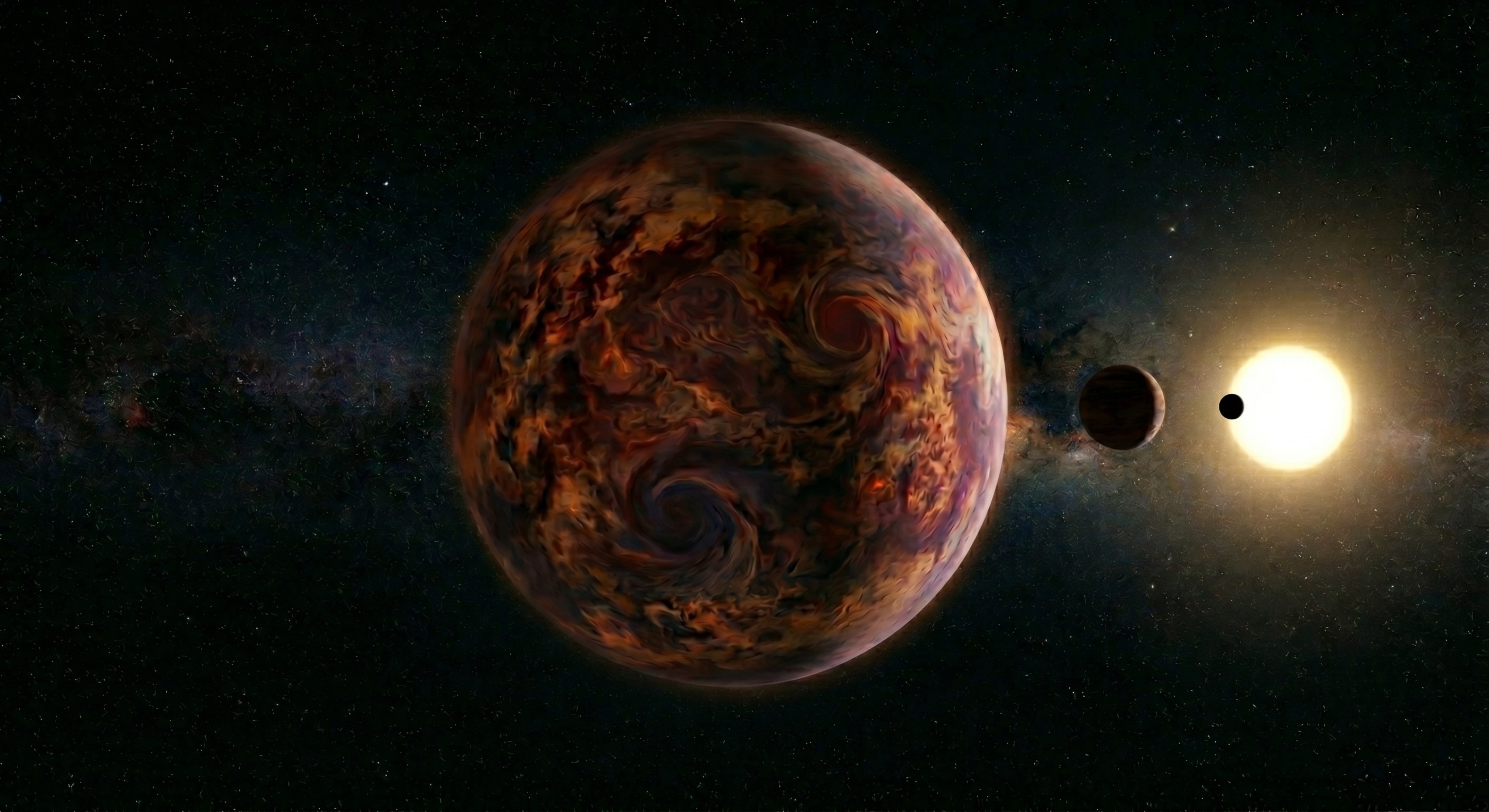
Credits: INAF / generated with AI Gemini
Rome, 17 June 2026 - By identifying a single, extremely rare "mono-transit" event in data sets from NASA's TESS mission, an international team led by the European Southern Observatory (ESO), with significant contribution from the National Institute for Astrophysics (INAF), has brought to light a planetary system that challenges our understanding of planet formation mechanisms. At the heart of the discovery is the massive brown dwarf TOI-201 c. Despite its highly elliptical orbit, this object allowed a multi-planet system to form within a narrow zone inside its orbit, presenting a completely new and unexpected scenario compared to commonly accepted models.
The study, published today in the journal Nature, carries a strong Italian imprint. Among the key authors are Luca Naponiello, an INAF researcher and the paper's second author, and his colleagues Aldo Bonomo and Alessandro Sozzetti. Furthermore, the collaboration involved researchers from the University of Milan and the University of Rome Tor Vergata.
TOI-201 c has a mass near the 'classical' upper limit for giant planets, standing out as a highly unique object. 'It is the transiting object with the longest orbital period for which the mass is known,' Naponiello notes, totalling about 2,881 days, highlighting its rarity and the significance of this discovery for space science.
However, the breakthrough revealed by this study is that the other two "tenants" hosted within the system are both transiting and arranged on orbital planes that are perfectly aligned and coplanar with the brown dwarf: a rocky super-Earth (TOI-201 d) with a period of just 5.8 days, and a gaseous warm Jupiter (TOI-201 b) located on an intermediate orbit of about 53 days. In fact, the brown dwarf TOI-201 c has a highly elliptical orbit (its eccentricity is 0.622), which, combined with its large mass, causes a severe gravitational perturbation, making regions at distances further than Mars is from the Sun dynamically unstable.
Astronomers define it as a restricted system: while it did not prevent their formation, "the presence of the brown dwarf on such an elliptical orbit forced the planets to form and survive by occupying the innermost and hottest edges of the primordial disk. Furthermore, the data show that during the close approach of the brown dwarf, the warm Jupiter undergoes strong and sudden variations in its transit timing, bearing witness to an intense and vigorous dynamic interaction currently underway between the two giants," the researcher highlights.
This result was achieved by combining photometric transits from space with a massive spectroscopic monitoring campaign from the ground. In addition to data from existing scientific literature, new radial velocity measurements were obtained using ESO spectrographs such as FEROS and PLATOSPEC.
'This discovery provides a crucial insight into how planets form even around massive, eccentric objects,' Bonomo emphasises. It challenges models that predict gas giants form beyond 2–3 astronomical units, inspiring confidence in ongoing research and future discoveries.
Objects with such long periods discovered via the transit method can be counted on one hand, and TOI-201 c is the first absolute one to have its mass confirmed through precise radial velocity measurements. Secondly, it represents "the first celestial body that can be characterised simultaneously through four different methodologies: namely, photometric transits, transit timing variations (TTV), radial velocities, and, as soon as the data from the Gaia DR4 release are published, space astrometry. With Gaia's fourth data release, we will also be able to reconstruct the 3D orbit of the brown dwarf," concludes Alessandro Sozzetti, director of the INAF-Astrophysical Observatory of Turin.
RELATED JOURNAL ARTICLE
“A very eccentric brown dwarf coplanar to a warm Jupiter and a hot super Earth”, Matías I. Jones, Luca Naponiello, Trifon Trifonov, Rafael Brahm, Gabriele Pichierri, Lorena Acuña-Aguirre, Robert J. De Rosa, Marcelo Tala Pinto, Aldo S. Bonomo, Luigi Mancini, Alessandro Sozzetti, Yared Reinarz, Alessandro Morbidelli, Néstor Espinoza, Giovanni Rosotti, Eric L. Nielsen, Stefan Y. Stefanov, Thomas Henning, Andrés Jordán, Jan Eberhardt, Artie Hatzes, Leonardo Vanzi, Jan Janik, and Petr Kabath, published in Nature.
MULTIMEDIA
This image can be used to cover this topic. Please include credits as follows. Click on the preview for the high resolution version.
Close-up artistic representation of the TOI-201 system. In the foreground is the massive brown dwarf TOI-201 c, followed by the hot Jupiter TOI-201 b (subject to strong gravitational perturbations), the star TOI-201, and finally the super-Earth TOI-201 d. Credits: INAF / generated with AI Gemini
INAF PRESS OFFICE
Marco Galliani | M +39 335 177 8428 - marco.galliani@inaf.it - ufficiostampa@inaf.it