NGC 362D: TWO RECORD-BREAKING FINDINGS SHED LIGHT ON THE EVOLUTION OF MILLISECOND PULSARS
An INAF- and University of Bologna-led research team has discovered a binary system caught in an exceptionally rare evolutionary stage, consisting of a millisecond pulsar and the youngest white dwarf ever observed in a system of this kind. The international study, published in Astronomy & Astrophysics Letters, also reports the first evidence of possible circumstellar material around such a young white dwarf, which may be a remnant of the stars' previous interaction.
Bologna, 30 September 2026 - A white dwarf caught at an exceptionally rare stage of its evolution, orbiting a neutron star that spins hundreds of times per second. NGC 362D offers astronomers a snapshot of a very early stage in the evolution of a binary system in which the two stars exchanged matter for millions of years. Today, the system consists of a millisecond pulsar and the star that once transferred matter to it, now in the earliest stages of its evolution as a white dwarf.
The international study, led by the Italian National Institute for Astrophysics (INAF) and the Alma Mater Studiorum University of Bologna, was published in Astronomy & Astrophysics Letters. NGC 362D was recently discovered through observations with the MeerKAT radio telescope in South Africa as part of the TRAPUM (TRAnsients and PUlsars with MeerKAT) project. The radio data allowed astronomers to characterise the pulsar and its binary system with high precision, determine its position, and search for its faint companion in archival Hubble Space Telescope images. These observations, collected between 2006 and 2016 in nine filters from ultraviolet to near-infrared wavelengths, allowed the team to identify the pulsar's companion and reconstruct its properties and evolutionary history by comparing them with stellar evolution models.
The analysis revealed that NGC 362D's companion is the youngest white dwarf ever identified in a binary system containing a millisecond pulsar. More precisely, it is a helium proto-white dwarf with a mass of just 0.18 solar masses, whose mass-transfer phase ended only about 600 million years ago, and which is still in the early stages of its evolution toward the white dwarf cooling sequence.
Remarkably, the study also reports another unprecedented feature. For the first time in a system of this kind, observations show that the white dwarf emits less ultraviolet light than expected, as if part of its radiation is attenuated before reaching us. One possible explanation is that some material still surrounds the star, perhaps left over from the mass-transfer process, absorbing part of its radiation before it reaches us.
“What makes this system particularly interesting is the possibility of observing it at a very early stage of its evolution,” explains Greta Ettorre, the study’s first author and PhD student at the Alma Mater Studiorum University of Bologna. “Moreover, the attenuation of the signal that we observed in the ultraviolet could indicate the presence of material still surrounding the white dwarf.”
To fully understand the significance of this result, we need to take a step back and reconstruct the history of this binary system. Millisecond pulsars are extremely compact neutron stars that can spin hundreds of times per second. This extraordinarily rapid rotation results from a prolonged process in which mass and angular momentum are transferred to the neutron star. It is like giving a spinning top an extra push, making it spin faster and faster.
This is known as the pulsar “recycling” mechanism. During this process, the donor star progressively loses its outer layers, eventually leaving behind a compact core that will evolve into a white dwarf. The Hubble observations allowed astronomers to identify the companion at this early evolutionary stage.
“NGC 362D currently offers us a unique opportunity to study what happens in the immediate aftermath of the millisecond pulsar recycling process,” says Emanuele Dalessandro, researcher at INAF and co-author of the study. “In this context, the possible presence of material around the white dwarf is particularly interesting. In fact, it could produce signatures at radio wavelengths in addition to the optical, similar to those observed in systems with non-degenerate companions, and could therefore help us correctly interpret the properties of other young systems.”
The significance of the result therefore extends beyond NGC 362D itself: identifying the signatures of these still poorly understood evolutionary stages could help astronomers correctly reconstruct the evolutionary histories of other millisecond pulsar systems.
“Millisecond pulsars rotate with extraordinary regularity and can be used as true natural clocks. Measuring the arrival times of their pulses with extreme precision allows us, among other things, to study gravity under extreme conditions and to carry out increasingly precise tests of general relativity. Understanding their surroundings and reconstructing their evolutionary history is therefore essential to fully exploit what these remarkable cosmic laboratories can tell us.” Ettorre concludes.
RELATED JOURNAL ARTICLE
“The youngest white dwarf companion to a millisecond pulsar: Insights from NGC 362D”, Greta Ettorre, Emanuele Dalessandro, Mario Cadelano, Alessandro Ridolfi, Cristina Pallanca, Paulo C. C. Freire, Vivek Venkatraman Krishnan, Maurizio Salaris, Franca D'Antona and Rouhin Nag, published in Astronomy & Astrophysics Letters.
MULTIMEDIA
These images can be used to cover this topic. Please include credits as follows.
Figure 1: The globular cluster NGC 362 observed by the Hubble Space Telescope with the Advanced Camera for Surveys (ACS). The image combines observations in blue and red light and in light emitted by hydrogen (Hα), allowing individual stars in the cluster to be distinguished. Credit: ESA/Hubble & NASA.
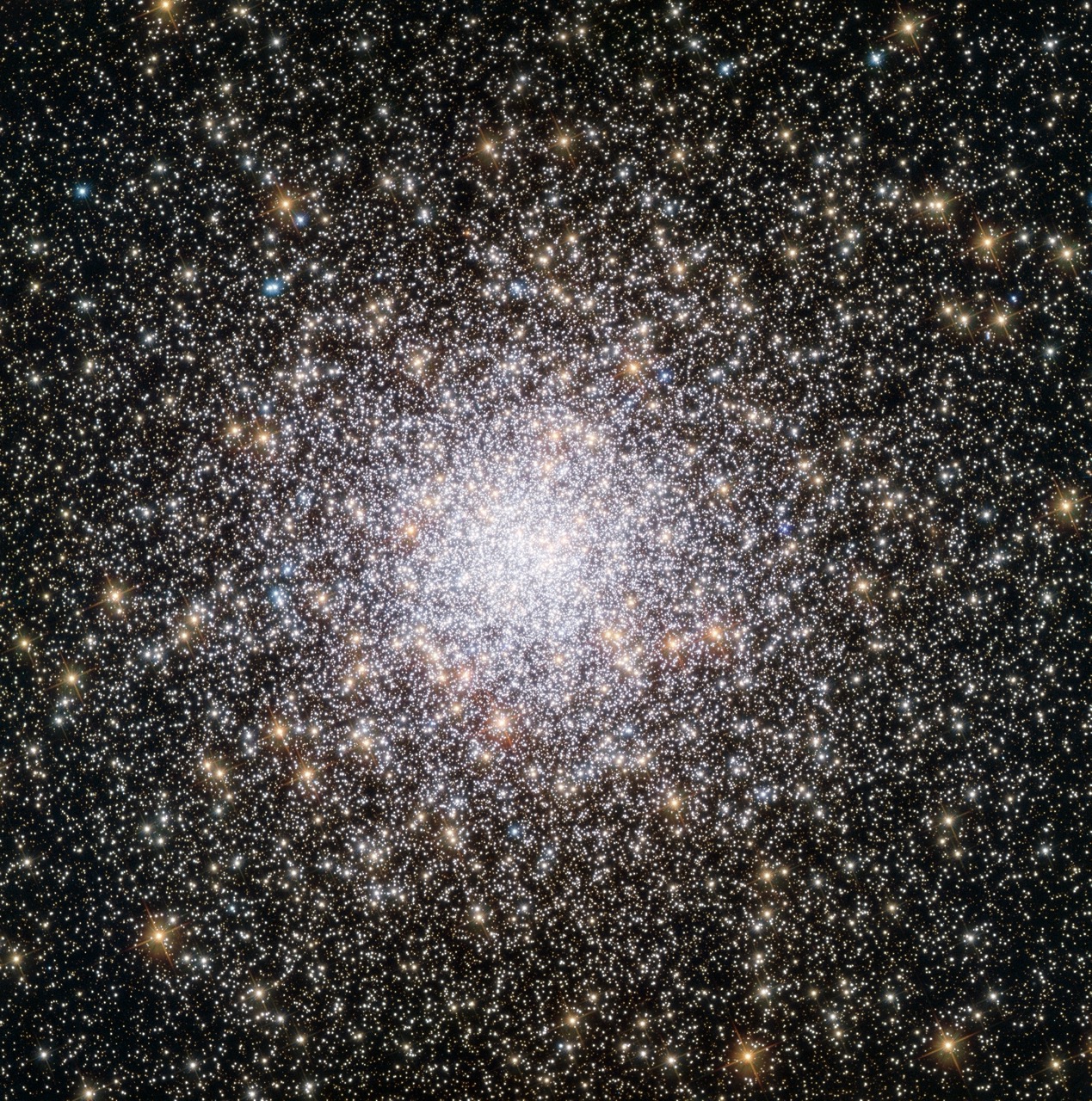
Figure 2: Artist's impression of the NGC 362D binary system. On the left, the neutron star emits beams of radio waves; on the right, the young white dwarf is surrounded by residual material from the previous mass-transfer phase. Image generated using artificial intelligence.
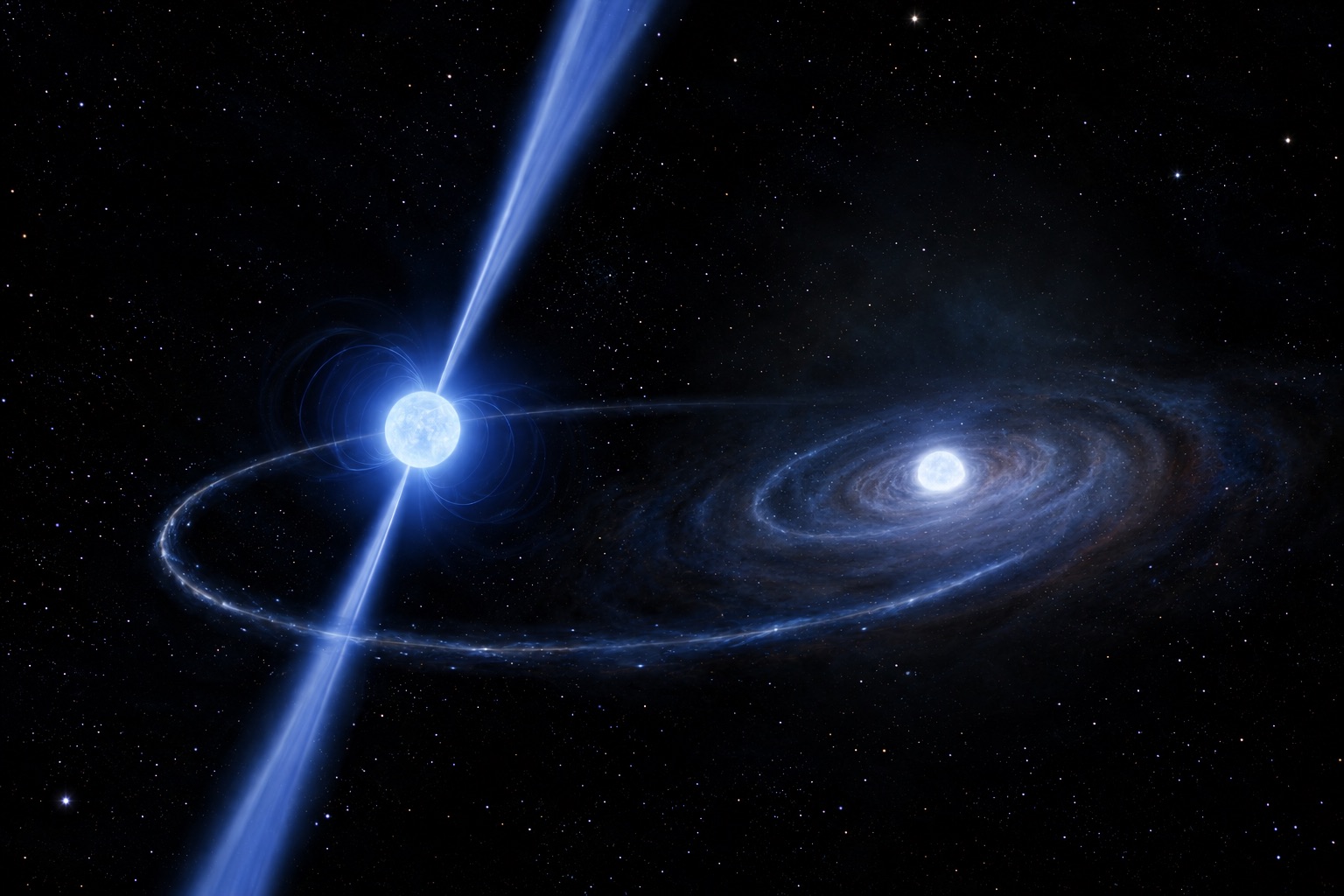
Photo: Greta Ettorre, first author of the study, researcher at INAF and a PhD student at the Alma Mater Studiorum University of Bologna.

INAF PRESS OFFICE
Marco Galliani | M +39 335 177 8428 - marco.galliani@inaf.it - ufficiostampa@inaf.it
Eleonora Ferroni | M +39 331 3144670 - eleonora.ferroni@inaf.it
www.inaf.it | www.media.inaf.it
Facebook | Instagram | X | Linkedin | YouTube | TikTok
UNIVERSITY OF BOLOGNA PRESS OFFICE
Matteo Benni | M +39 338 786 6108 – matteo.benni@unibo.it – ufficiostampa@unibo.it
Viviana Sarti | M +39 366 824 9402 – viviana.sarti@unibo.it
www.unibo.it | www.magazine.unibo.it
Facebook | Instagram | LinkedIn | YouTube | TikTok